How AI prompting turned writerly description into an everyday skill
How AI prompting turned writerly description into an everyday skill
Publish Date: 2026-06-21 08:37:00
Source Domain: theconversation.com
You are sitting at your computer, interacting with a generative AI model like ChatGPT Image or Midjourney. You have a distinct picture in your mind, and you begin with a simple, general prompt: a chair in a cozy room.
The image appears, but you frown. You realize that to get what you want, you must elaborate, so you experiment with more descriptive prompts: Dark mahogany wood. Dim yellow lamplight. Late autumn dusk. You keep revising, trying to discover which words the machine needs and which words it ignores.
You are wrestling with a problem: how do you describe a feeling? How do you communicate warmth, melancholy, intimacy or calm — not to another human being, but to a machine?
This is one novel frustration of the AI age, yet millions of users searching for the “right prompt” are engaging in an old literary practice: turning mental images, vague desires and atmospheric intuitions into precise language.
Modernist writers and description
Generative AI has transformed description from a literary technique into a mass social skill.
This frustration in fact has an unexpected literary history. More than a century ago, writers faced a similar question when new visual technologies began to change how reality could be represented. Photography, and later cinema, could capture surfaces, bodies and landscapes with a speed and accuracy prose could not match. If machines could show the visible world more efficiently than language, what was writing for?
In Strange Likeness: Description and the Modernist Novel, literary scholar Dora Zhang argues that many early 20th-century novelists responded by rethinking the role of description itself.
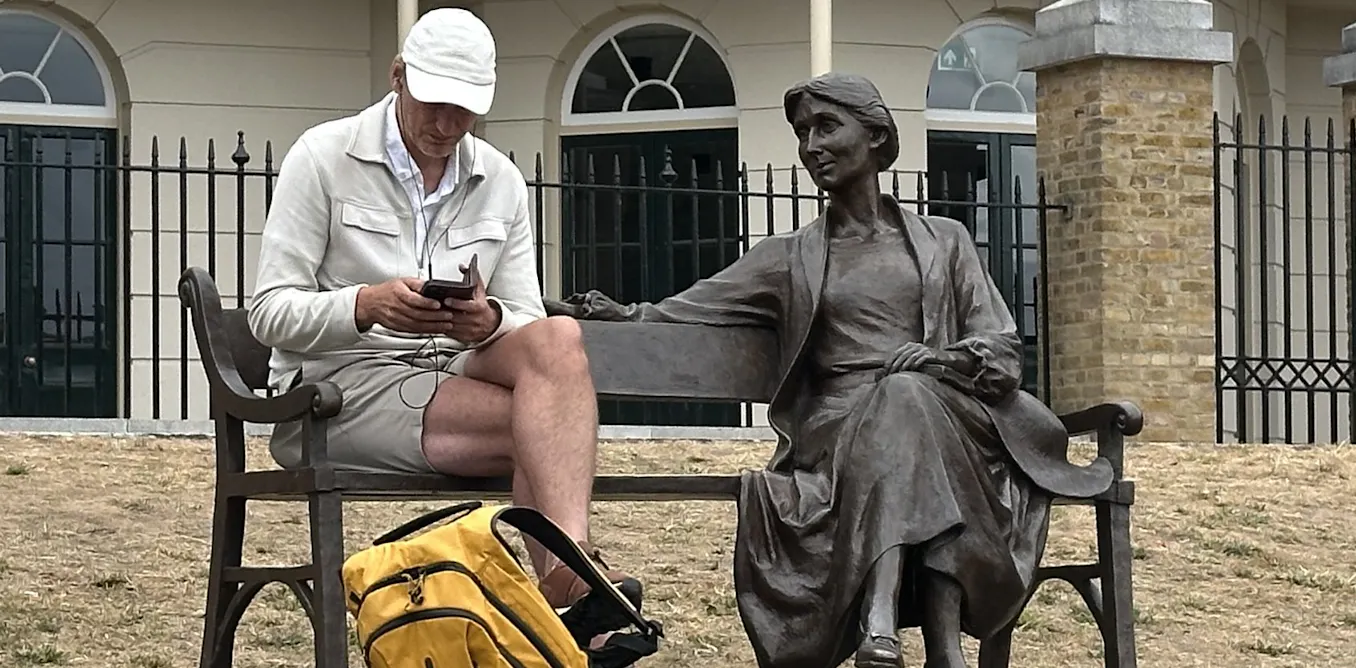
Modernist author Virginia Woolf, among others, sought to capture the shifting textures of consciousness.
(Harvard University Library/Wikimedia)
Rather than competing with cameras in the faithful rendering of objects, modernist writers such…