AI model predicts hydrogen atom positions in crystal structures
AI model predicts hydrogen atom positions in crystal structures
Publish Date: 2026-06-19 04:48:00
Source Domain: www.chemistryworld.com
An artificial intelligence (AI) model is able to fill in missing or incorrectly placed atoms – such as hydrogen – in the crystal structures of inorganic materials. Refining atomic positions in this way may allow chemists to better simulate material structures or help design new materials, such as superconductors.
Determining the positions of hydrogen and other small atoms in crystalline materials is challenging as these species scatter x-rays weakly, meaning techniques such as x-ray powder diffraction can lead to inaccurate structures. While neutron or synchrotron diffraction experiments are more accurate, these require access to large facilities, require more material and are expensive to run.
‘I remember once I wanted to compare the results of our predictions of the crystal structure of cellulose with experiments,’ says Artem Oganov at Skolkovo Institute of Science and Technology in Russia, who wasn’t involved in the new work. Despite being the most abundant polymer on Earth, he says that the crystal structure still had missing hydrogen atoms.
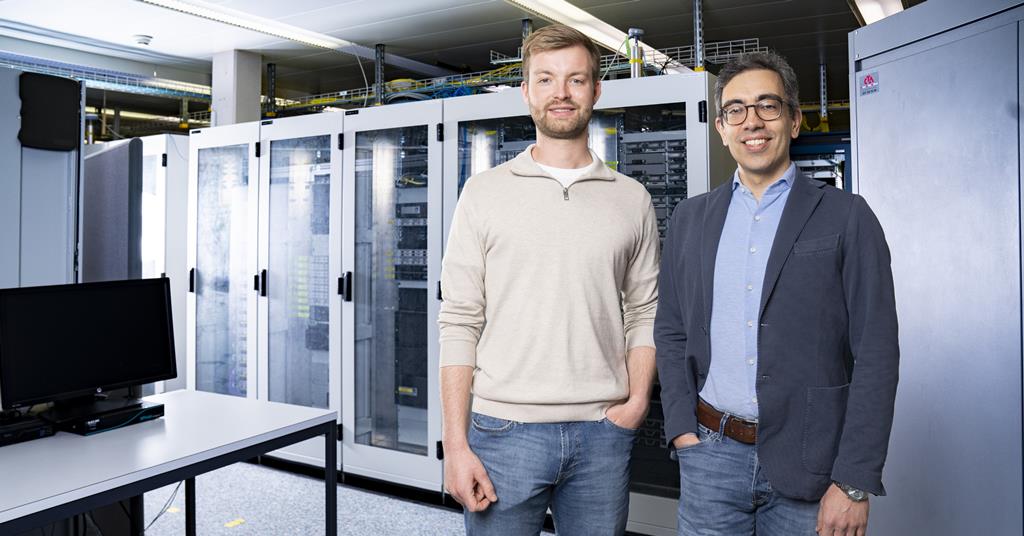
‘If we don’t know where the atoms sit, there’s no way for us to simulate the material,’ says Timo Reents, a PhD student at the PSI Centre for Scientific Computing, Theory and Data in Switzerland, who developed the model. Varying atomic positions can affect the properties of materials, including thermal or electrical conductivity, vibrational spectra and superconductivity in hydride materials.
What is AI?
Artificial intelligence (AI) is an umbrella term often incorrectly used to encompass a variety of connected but simpler processes.
AI is the ability of machines and computer programmes to perform tasks that typically only humans could do, such as reasoning, responding to feedback and decision making.
Generative AI is a newer variant of AI that analyses and detects patterns in training datasets to generate original text, images and videos in response to requests from users. ChatGPT, Microsoft…