Hastings College student examines AI’s role in declining literacy rates
Hastings College student examines AI’s role in declining literacy rates
Publish Date: 2026-06-15 17:50:00
Source Domain: www.hastings.edu
Artificial intelligence, or AI, can generate answers in seconds — but at what cost to student learning and literacy rates? That question was at the center of a presentation by Hastings College student Madi Holman at this year’s Academic Showcase.
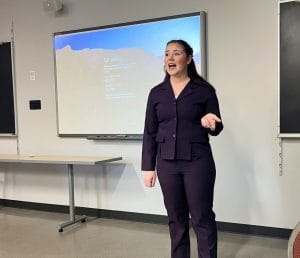 Madi Holman giving her Academic Showcase presentation on AI and literacy rates.
Holman, a first-year student from Franklin, Nebraska, is a member of the College’s forensics (speech) team. For Academic Showcase, the art and secondary education major delivered a persuasive and humorous speech addressing concerns about declining literacy rates and the growing role of AI in classrooms.
Academic Showcase, held each spring at Hastings College, provides students the opportunity to share presentations and performances with the community. Classes are canceled for the day to allow full participation.
Holman opened her presentation by outlining various forms of literacy — media, digital, critical, informational, reading and writing — before introducing research and data to support her claims.
According to a study done in 2025, literacy rates have been declining steadily since 2013, with increased technology use in classrooms cited as a contributing factor. This use, combined with the lack of regulations placed on school devices until recently, has taken away from students’ ability to do independent research.
“Only a fourth of eighth grade students are at the recommended reading level,” Holman stated.
 Holman also participated in forensics (speech), where she made the national quarterfinals in dramatic interpretation.
She also addressed the lack of clear guidance for teachers navigating AI tools, noting that many are frustrated with students relying on platforms such as ChatGPT and Grammarly to complete assignments. These tools, both forms of generative AI, compile responses based on prompts, which can sometimes lead to misinformation or oversimplified information.
“Teachers love completed work,” Holman…