Industrial Vacuum Cleaner Market Size Projected to Reach USD
Industrial Vacuum Cleaner Market Size Projected to Reach USD
https://www.openpr.com/news/4480015/industrial-vacuum-cleaner-market-size-projected-to-reach-usd
Publish Date: 2026-04-20 08:01:00
Source Domain: www.openpr.com
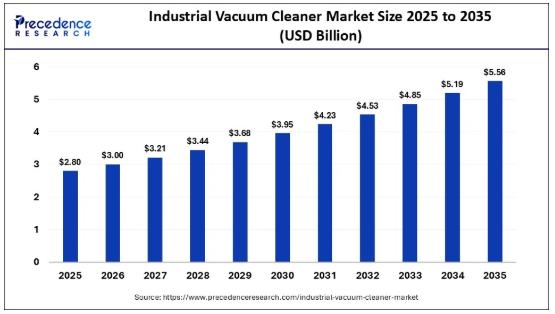
According to Precedence Research, the global industrial vacuum cleaner market size is projected to reach around USD 5.56 billion by 2035, increasing from USD 2.80 billion in 2025, expanding at a CAGR of 7.10% from 2026 to 2035. The surge is largely fueled by increasing workplace safety regulations, rising industrialization, and the growing need for efficient dust and hazardous waste management solutions across industries such as manufacturing, pharmaceuticals, and food processing.
Industrial environments today demand high-performance cleaning systems capable of maintaining hygiene, minimizing downtime, and ensuring regulatory compliance. As a result, industrial vacuum cleaners equipped with advanced filtration systems like HEPA are becoming indispensable across sectors.
Where Data Meets Strategic Clarity 📥 View Sample Pages of the Complete Report 👉 https://www.precedenceresearch.com/sample/8314
Why Are Industrial Vacuum Cleaners Gaining Momentum?
Industrial vacuum cleaners are essential tools in environments where dust, debris, and hazardous particles pose operational and health risks. These machines are engineered for continuous operation, high suction power, and advanced filtration, making them ideal for demanding sectors such as construction, cement, pharmaceuticals, and food processing.
The market is expanding steadily due to heightened awareness of workplace hygiene and increasingly stringent environmental regulations. Additionally, infrastructure development and industrial expansion in emerging economies are further boosting product adoption.
How is AI Transforming the Industrial Vacuum Cleaner Market?
Artificial intelligence is revolutionizing industrial cleaning by enabling real-time monitoring and predictive maintenance. AI-powered sensors can track dust levels, filter efficiency, and equipment performance, ensuring optimal operation and reducing unexpected downtime.
Furthermore, integration with IoT platforms allows…