Seahorses and shark fins are illegally trafficked. An AI tool could help stop this crime
Seahorses and shark fins are illegally trafficked. An AI tool could help stop this crime
Publish Date: 2026-06-07 19:31:00
Source Domain: theconversation.com
Shark fins on a plane, seahorses in your bag and sea cucumbers in the post – these are just a few examples of illegal marine wildlife trafficking.
This crime can be hard to detect. But in a new study, published in the journal Frontiers in Ocean Sustainability, we show how artificial intelligence (AI) can be harnessed as a complimentary detection tool to help stop marine wildlife trafficking at international airports and mail facilities.
A global crime
The cross-border trade in live animals, animal parts or products is a global crime, facilitating the flow of billions of illicit dollars each year. It’s known to converge with other criminal activity, including the trafficking in drugs, arms and humans.
The United Nations Office on Drugs and Crime identifies five sources of demand for wildlife trafficking: food, medicine, pets and ornamental plants, specialist collection and adornment.
In some cases, such as pet prestige, people are motivated both by the desire to have a pet and the perceived status it brings to own an exotic animal.
People traffic marine animals too
Wildlife trafficking affects around 4,000 species. Many of the more well-known examples involve land-based animals – ivory from elephant tusks, horns from rhinos and scales from pangolins – the world’s most trafficked mammal.
Closer to home, we also see native Australian reptiles and birds, sometimes shoved in tins, put in socks and packaged up live to be sent overseas.
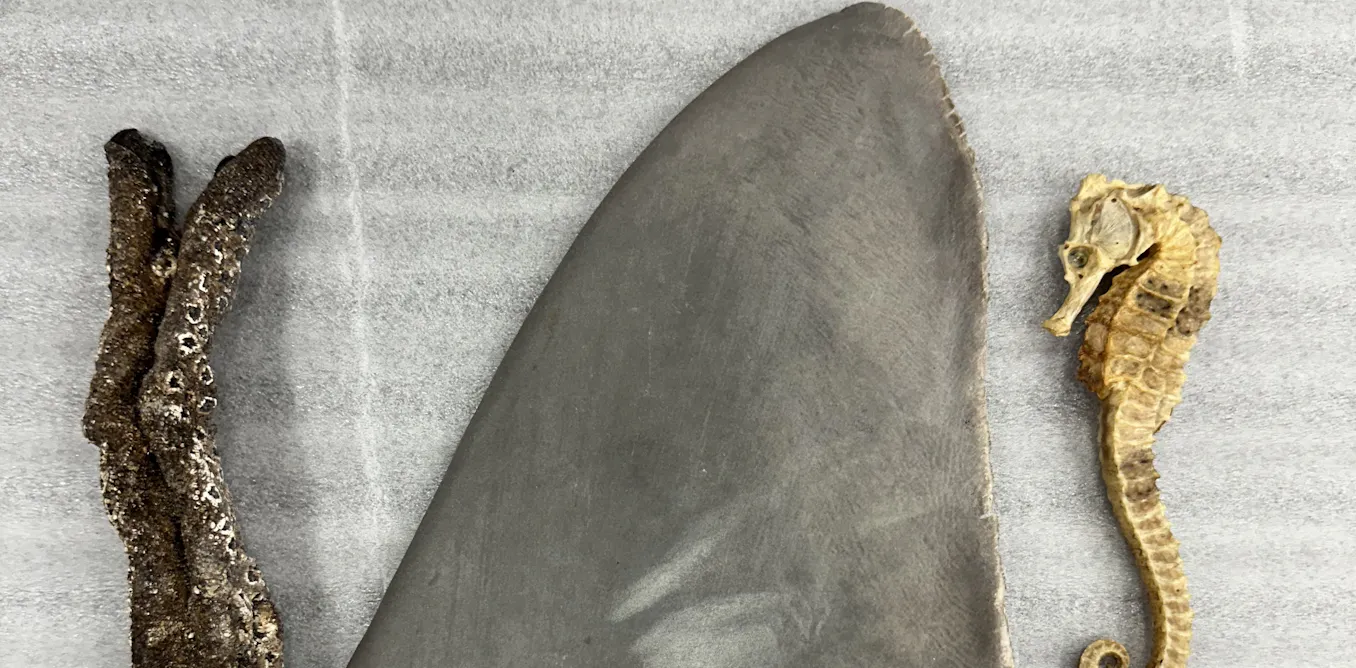
Marine creatures, unfortunately, are targeted too. This can include live animals such as fish in people’s bags, or dried marine life such as the rise of the seahorse trade and demand for shark fin.
We have small pockets of knowledge of this activity. But the reality is we don’t fully understand how widespread it is.
AI to detect marine wildlife trade
Currently, the best means of detecting illegally trafficked wildlife is humans. And then there are our four-legged friends: biosecurity dogs….