Will Technology Offset the Loss of 200,000 Truck Drivers Due to the New DOT Regulations?
Will Technology Offset the Loss of 200,000 Truck Drivers Due to the New DOT Regulations?
https://thepeopleseconomist.substack.com/p/artificial-intelligence-versus-immigration
Publish Date: 2026-02-15 10:28:00
Source Domain: thepeopleseconomist.substack.com
On February 12, 2026, trucking and logistics stocks suffered a sharp equity market sell-off that few had anticipated just weeks earlier. Shares of RXO, C.H. Robinson, Expeditors International, XPO, and J.B. Hunt suffered stock price losses that ranged from -5.0% to -20.5% in a single session. The catalyst was not due to higher fuel costs, labor unrest, or a recession signal. Instead, it was the unveiling of a new artificial intelligence freight-scaling platform by Algorhythm Holdings.
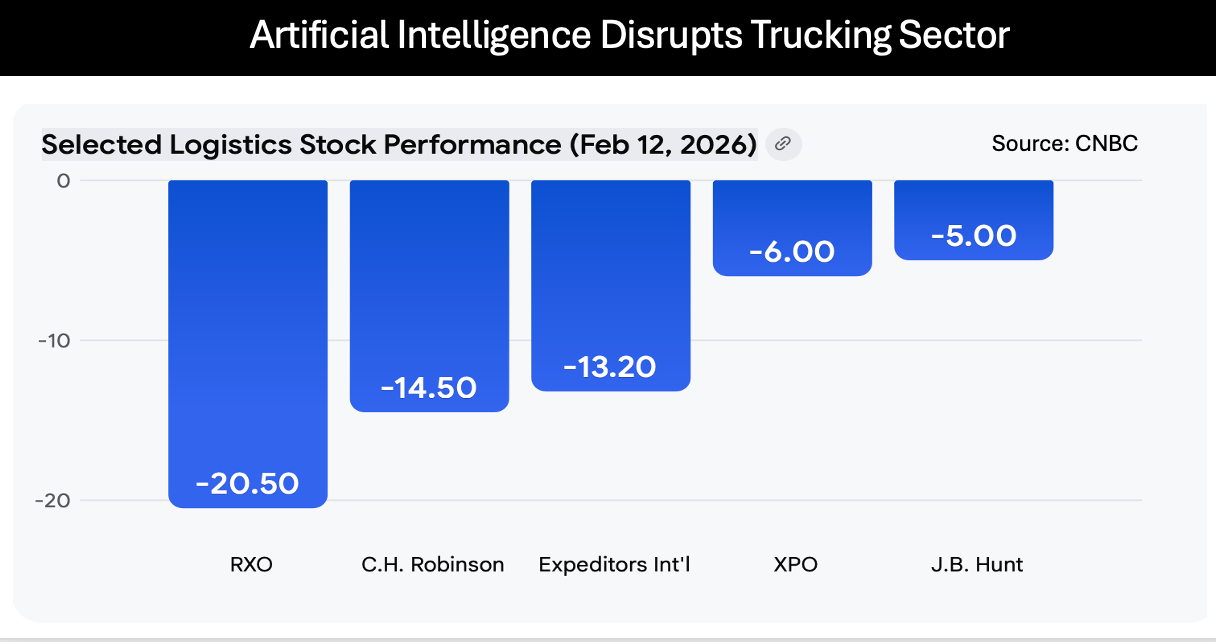
Source: CNBC
The company’s Semi-Cab AI tool is expected to reduce empty miles by more than 70% and enable operators to scale freight volumes by 300%-400% without increasing headcount. In an industry where margins are thin and labor costs high, those claims were disruptive. Investors quickly extrapolated a future in which AI erodes pricing power, commoditizes routing, and pressures traditional operators to invest aggressively in technology to survive.
Yet the artificial intelligence (AI) shock came just one day after an even more consequential policy development. On February 11, 2026, the U.S. Department of Transportation (DOT) finalized a rule that fundamentally reshapes the commercial driver labor pool. The rule, implemented through the Federal Motor Carrier Safety Administration, eliminates eligibility for “non-domiciled” commercial driver’s licenses (CDLs) for individuals holding Deferred Action for Childhood Arrivals (DACA), Employment Authorization Documents (EADs), Temporary Protected Status (TPS), or asylum status. It also bars non-domiciled commercial learner’s permit holders from converting those permits into full CDLs. Effective March 16, 2026, the rule is expected to remove approximately 194,000 drivers from the market over the next two years—roughly 5% to 8% of the interstate CDL workforce.
For logistics networks such as UniGroup, parent of United Van Lines and Mayflower Transit, these twin developments represent a paradox: technological abundance colliding with…

