From Data Platforms to Enterprise AI Outcomes: Architecting Governed, Scalable AI Systems
From Data Platforms to Enterprise AI Outcomes: Architecting Governed, Scalable AI Systems
Publish Date: 2026-02-03 06:05:00
Source Domain: aijourn.com
Enterprise leaders ask a pointed question: why does artificial intelligence deliver convincing demonstrations yet fail to reshape how the organization actually makes decisions?
The constraint sits upstream from models and algorithms. AI systems operate inside data platforms, access controls, and governance structures that determine how information moves across the enterprise. When those foundations are fragmented or poorly defined, AI produces disconnected insights instead of dependable outcomes.
Enterprise AI architecture establishes the foundation that determines whether AI delivers repeatable outcomes or isolated results. Without that foundation, each new AI initiative increases complexity faster than it creates value.
Why Enterprise AI Struggles to Move Beyond Pilots
AI pilots succeed when the environment remains controlled. A small team tunes a model on a narrow dataset. A demonstration paints a compelling scenario. Real use, where hundreds of teams depend on stable data and insights daily, exposes gaps.
Survey research emphasizes this point. IBM reported that about 42 percent of enterprises with more than 1,000 employees had actively deployed AI across business functions, while another 40 percent were still experimenting without full deployment. This means a significant share of organizations has not crossed the threshold from experimentation into sustained enterprise use.
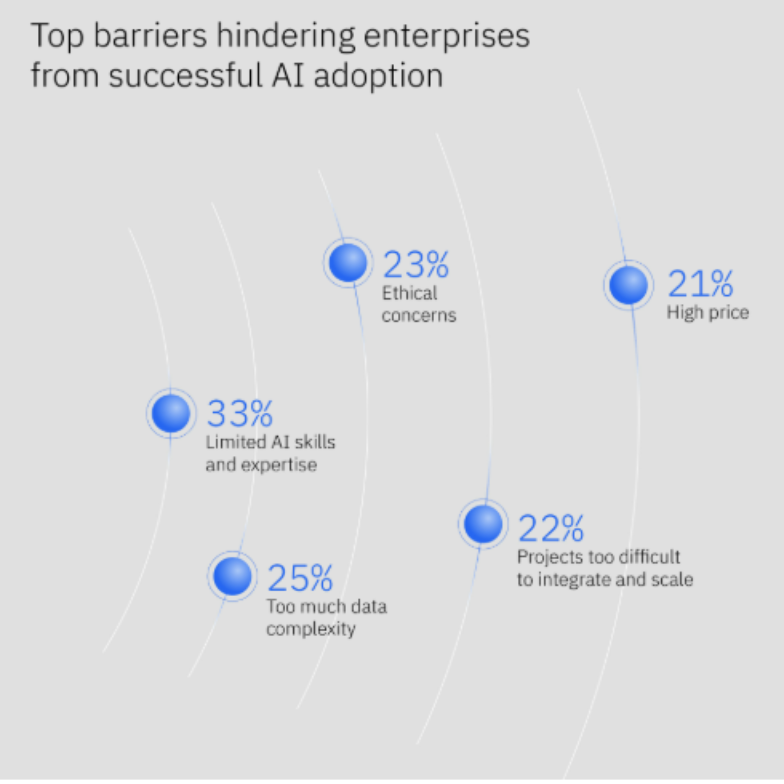
Image: Illustration showing pop barriers hindering enterprises from successful AI adoption | Source: IBM
These barriers expose gaps in AI strategy for enterprises, particularly around governance and data readiness. Many teams cite data complexity as a major challenge, indicating that data readiness and integration remain structural blockers even as adoption grows.
These patterns show that pilots often succeed on isolated data and workflows. Enterprise outcomes require scalable AI platforms that sustain stability, consistency, and accountability as adoption grows.