An AI-Powered Control System For Robots With Legs
An AI-Powered Control System For Robots With Legs
https://seas.harvard.edu/news/ai-powered-control-system-robots-legs
Publish Date: 2026-07-06 16:02:00
Source Domain: seas.harvard.edu
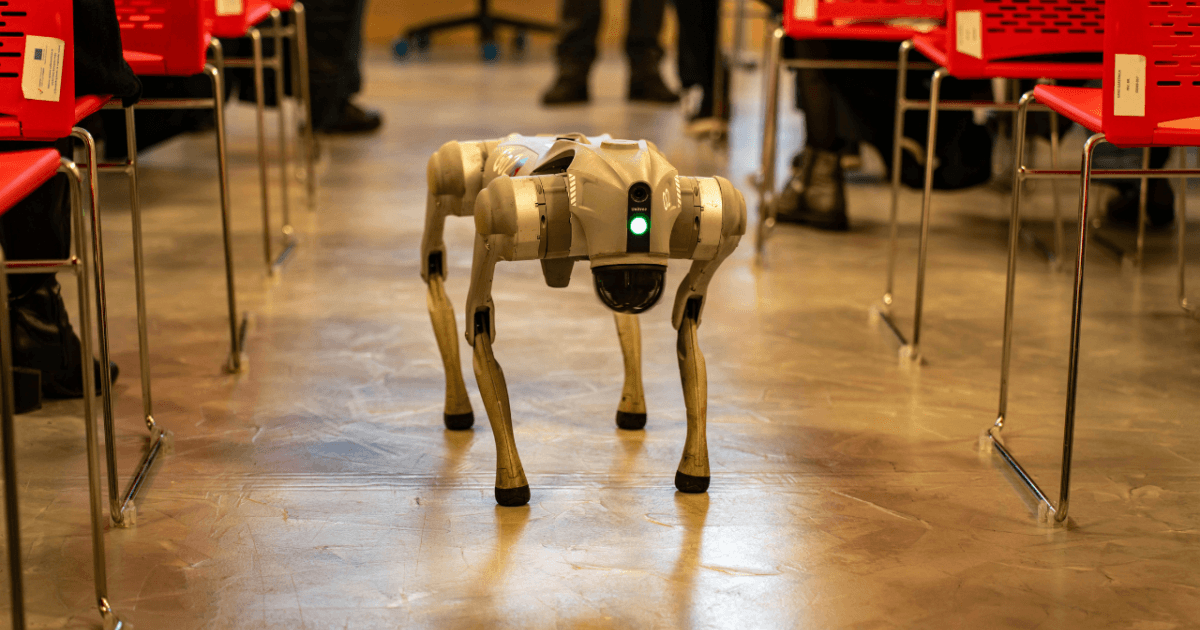
Walking robots, such as quadruped robotic dogs, must be able to safely move through rough, often changing environments.
Today, there are two main ways to program walking or legged robots. The first is called model predictive control. This technique optimizes the robot’s behavior but relies on accurate dynamics models, which are challenging to achieve in real-world settings and often require simplifying assumptions. The second is model‑free reinforcement learning, which allows the robot to learn reliable but fixed behaviors, making them difficult to adapt after training.
Now, a team led by Yilun Du, assistant professor of computer science at the Harvard John A. Paulson School of Engineering and Applied Sciences (SEAS) and a Kempner Institute investigator, has developed a new, artificial intelligence-based robotic control system that allows four‑legged robots to adapt their movements quickly to new tasks and terrains without any retraining. They presented this work at the June IEEE International Conference on Robotics and Automation (ICRA).
Du and colleagues created a system they call Diffusion-MPC (Model Predictive Control), which aims to combine the best aspects of existing methods. At the core of Diffusion‑MPC is a generative diffusion model, a type of AI system commonly used in image generation.
Instead of a fixed, scratch-built model, the Diffusion-MPC method deploys an approximate model of how the robot and its environment will evolve over time. This model then helps the robot plan tasks, which are refined by rewarding good performance while enforcing constraints, such as physical limits and safety rules.
Since rewards and constraints are incorporated in real time, the Diffusion-MPC model can adapt to new tasks – such as changing speed, direction, or gait – without additional retraining.
The team demonstrated their research model on real legged robots. They showed that the robots can move stably while…