Quanten Technologies Inc. Introduces Next-Generation Robotic Actuator Motors at the 2026 Robotics Summit
Publish Date: 2026-06-25 13:00:00
Source Domain: www.businesswire.com
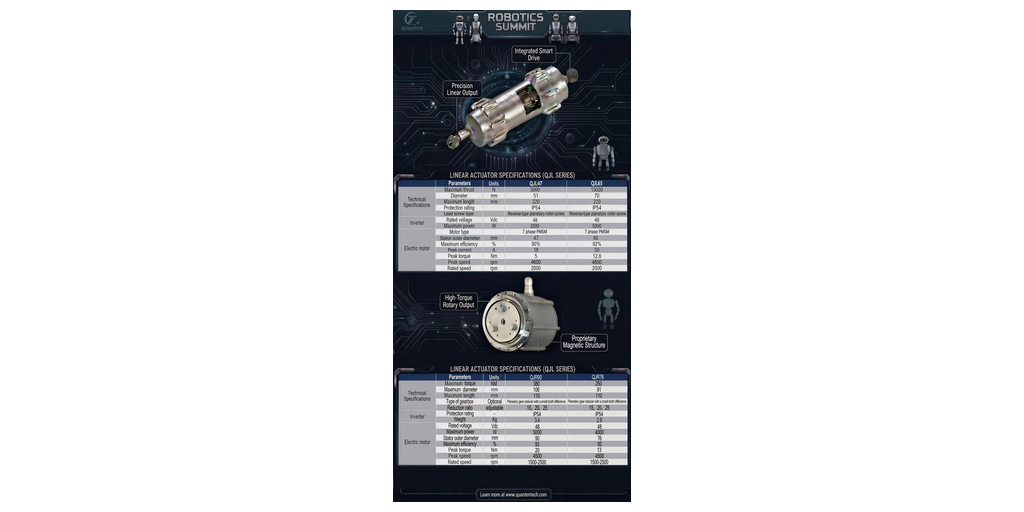
BOSTON–(BUSINESS WIRE)–Quanten Technologies Inc., a pioneer in advanced electric motor technology, recently debuted its latest breakthrough innovations at the annual Robotics Summit & Expo in Boston. Quanten officially introduced the QJL series motor and drive solutions for linear actuators and the QJR series solutions for rotary actuators, a complementary suite of motion solutions specifically engineered to meet the stringent power, weight and efficiency demands of advanced humanoid robotics, and presented its industry-leading technology in an onsite seminar titled Building Powerful and Efficient Robot Motors through Smart Multi-Phase Technology.
“The true bottleneck hindering the robotics revolution isn’t just software or AI, it is also physical actuation. Traditional motors are simply not efficient or lightweight enough to support industrial adoption.”
Share
Designed for seamless structural integration, the QJL series optimizes linear movement in robotic limbs, while the QJR series provides high-torque rotary motion for high-power joints. Together, these products deliver a significant leap in power-to-weight performance, achieving a 30% weight reduction and a 50% thrust increase compared to conventional alternatives.
The foundation of this drastic improvement is Quanten’s proprietary Multi-phase Dynamically Reconfigurable Permanent Magnet Synchronous Motor (DR) technology, which represents a major departure from industry standard three-phase Brushless DC (BLDC) systems. Quanten’s DR motors unlock unprecedented efficiency gains across the entire operational spectrum:
- Heavy-Load Efficiency: Elevates efficiency from the standard 50% range found in BLDC motors up to an extraordinary 70% range, cutting the power-loss and heat-generation by 2X while providing superior peak power and torque for robots.
- Nominal-Load Efficiency: Enhances efficiency from 80% to 90% for typical load ranges that a robot motor would spend most of its time in. By cutting…