New technology would boost energy efficiency at data centers

New technology would boost energy efficiency at data centers
Publish Date: 2026-06-22 11:51:00
Source Domain: www.binghamton.edu
Artificial intelligence is increasingly a part of our everyday lives, and tech companies are building more data centers to accommodate the spike in computer processing.
Meeting the demands from thousands of new machines plugged into the power grid can be tricky, so promoting energy efficiency has become more important than ever.
Associate Professor Pritam Das Image Credit: Jonathan Cohen.
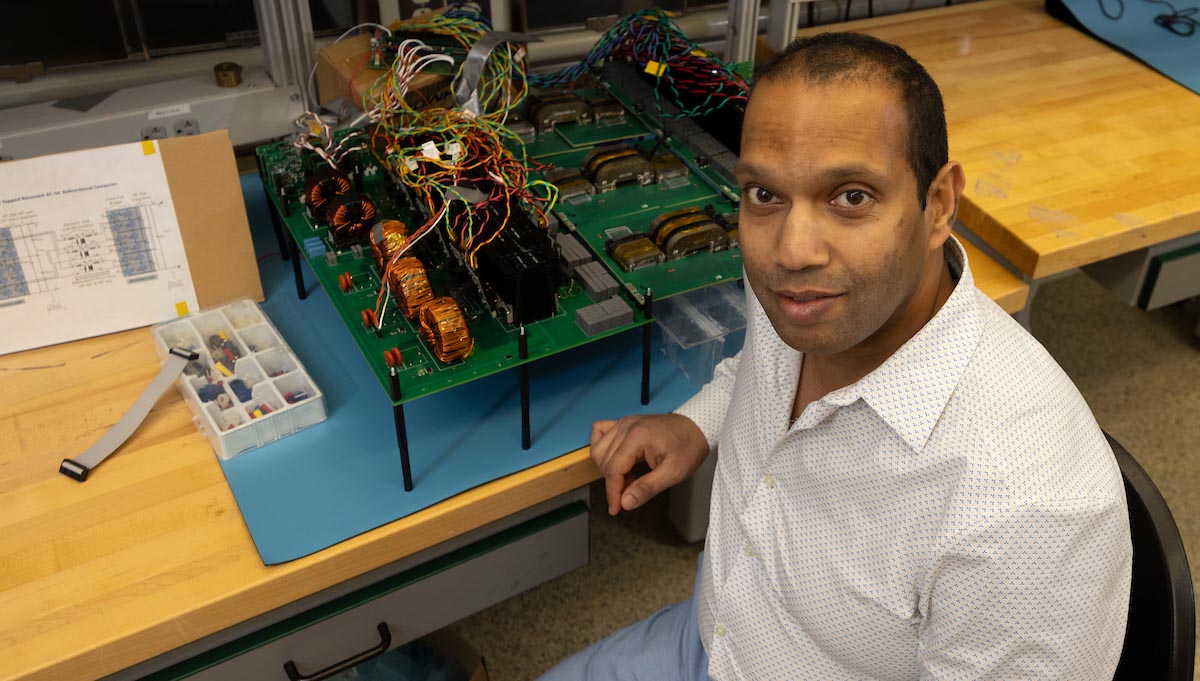
Associate Professor Pritam Das Image Credit: Jonathan Cohen.
Through his research at Binghamton University, Associate Professor Pritam Das has developed technology that could help. Now, thanks to a program supported by the National Science Foundation, he’s hoping to get it out to the marketplace.
Das — a faculty member at the Thomas J. Watson College of Engineering and Applied Science’s Department of Electrical and Computer Engineering — has one patent issued and another one pending. He recently received $100,000 from the University’s Excellence in Entrepreneurship and Discovery (EXCEED) program, supported by an NSF Accelerating Research Translation (ART) grant. He plans to use these funds for prototyping, data collection, and the evaluation of the Binghamton University inventions, to encourage a startup company to build a commercial model for industry partners.
As AI data centers proliferate and scale, and AI hyperscalers like Amazon Web Services, Microsoft Azure, and Google Cloud push for increased performance, challenges have emerged in powering critical AI graphics processing units (GPUs). Moore’s law — which for many years promised that the number of transistors on a microchip would double every two years — has reached its limit. Also, physical CMOS (complementary metal-oxide-semiconductor) transistors — which are the…