Steering open-source AI to accelerate the sustainable development goals
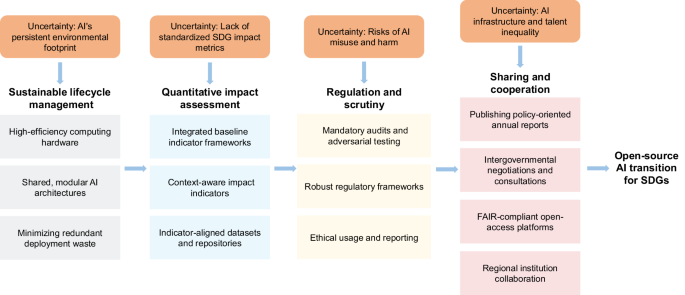
Steering open-source AI to accelerate the sustainable development goals
https://www.nature.com/articles/s41467-026-73866-8
Publish Date: 2026-06-11 05:52:00
Source Domain: www.nature.com
The 2025 AI Action Summit revealed that there are even more challenges in this area than initially anticipated in the absence of dedicated governance actions. Hence, we propose a set of actions that encompasses lifecycle management, impact assessment, regulatory policy, and shared mechanisms to ensure that open-source AI solutions tangibly advance progress toward the SDGs.
Integrate sustainability into open-source AI lifecycle management
Integrating sustainability across the AI lifecycle requires a multi-pronged strategy that addresses computing hardware, model development, and application deployment25, which could shift from fragmented reinvention to governed commons. The computing hardware phase requires a fundamental shift toward high-efficiency computing, built on the principles of energy-efficient architectures, liquid cooling, and renewable energy, which have demonstrated significant environmental benefits such as reducing data center energy demand by up to 20% and water consumption by up to 52%26. In the model development phase, creating shared, modular AI architectures can eliminate the immense waste from redundant development efforts. For example, using model distillation and pruning techniques can result in an overall Large Language Model compression of around 70%27. In the deployment and application phase, it is essential to mitigate waste from the redundant deployment of numerous similar models by transitioning towards a deployment-centric framework that prioritizes the use of multimodal foundation models as reusable infrastructure28. In addition, many technical efficiency metrics are vital for sustainability in the AI lifecycle, such as Power Usage Effectiveness and carbon emissions per training or inference. Beyond these metrics, effective governance requires a broader “Return on Environment” indicator29. This evaluates the net contribution of open-source AI to the SDGs by balancing its direct environmental costs against the benefits it…