Pope Leo sees beauty in “wasting time together”
Pope Leo sees beauty in “wasting time together”
Publish Date: 2026-05-29 05:06:00
Source Domain: www.wbur.org
When Cardinal Robert Prevost was elected Pope in May 2025 and took the name Leo, most in-the-know experts took this as a sign that the new pontiff intended to honor Pope Leo XIII.
Best known for his 1891 encyclical “Rerum Novarum or Of Revolutionary Change,” Pope Leo XIII ushered in the modern era of Catholic social teaching by addressing the rights of workers, the needs of the poor and the dignity of the individual. In that landmark encyclical, the Church committed to be a voice of justice for the poor and called on the faithful to stand up to the seemingly inexorable forces present at the dawn of the Industrial Age: greed, unfettered capitalism and dehumanizing automation.
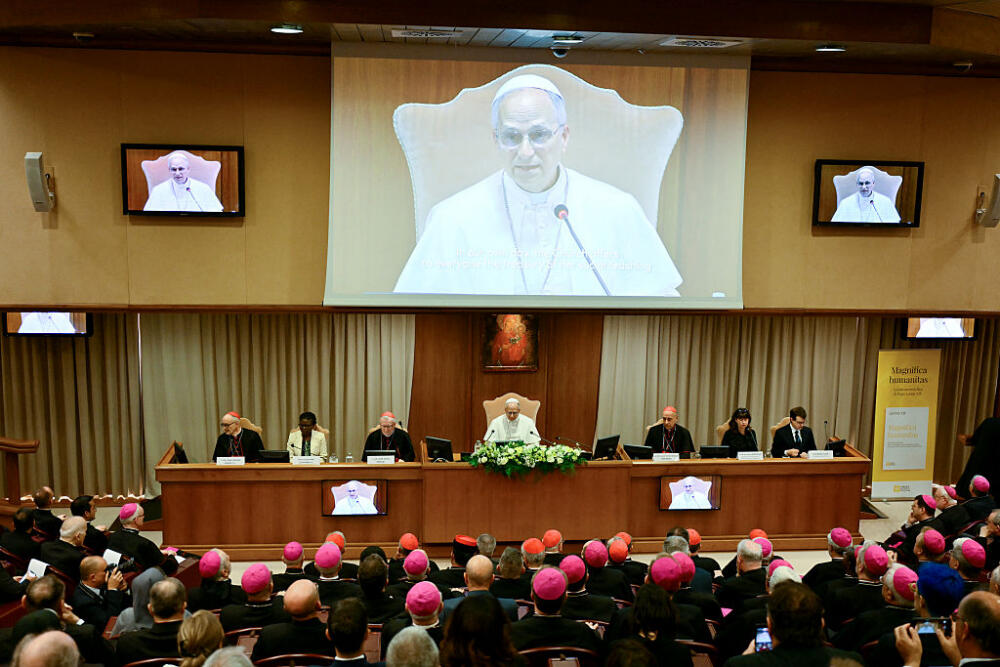
In Pope Leo’s “Magnifica Humanitas,” signed on May 15, 2026, exactly 135 years after “Rerum Novarum” was released, Pope Leo XIV addresses the artificial intelligence (AI) revolution — a moment not unlike the one his predecessor faced — where rapid and unregulated technological innovation, combined with concentrated wealth, power and greed, could work in concert to destabilize large swaths of humanity. The document offers a strong and compelling moral framework for how to address the opportunities of AI and the dangers of dehumanization and commodification in a world where data-driven decision-making can often trump human judgement, relationships and love.
Like “Rerum Novarum,” “Magnifca Humanitas” offers a compelling moral framework for how to address the promise and the peril of AI.
Though Pope Leo XIV was careful to draw the intellectual throughline of Catholic social thought from “Rerum Novarum” through the Second Vatican Council, and on to the writings of his recent predecessors St. John Paul II, Pope Benedict XVI and Pope Francis, I was more struck by the discontinuity between the writing of Pope Leo XIII and Pope Leo XIV.
In a moment where authoritarian voices are gaining traction globally and where polarization and disconnection are on the rise, Pope Leo XIV…