AI in Food and Beverages Market Trends: Smart Manufacturing, Automation & Forecast to 2034
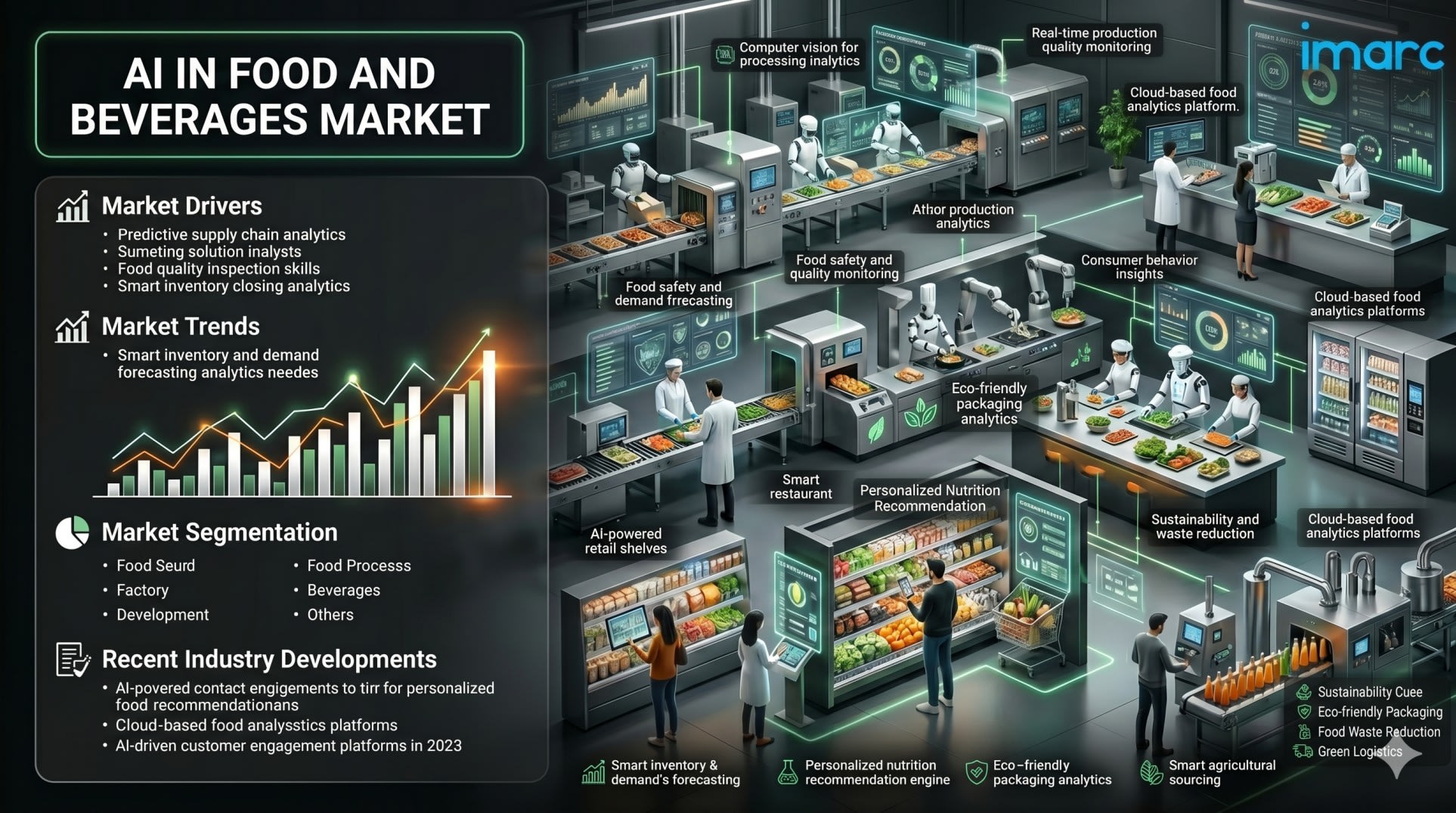
AI in Food and Beverages Market Trends: Smart Manufacturing, Automation & Forecast to 2034
Publish Date: 2026-05-29 04:59:00
Source Domain: vocal.media
According to IMARC Group’s latest research publication, The global artificial intelligence (AI) in food & beverages market size reached USD 13.1 Billion in 2025. Looking forward, IMARC Group expects the market to reach USD 136.5 Billion by 2034, exhibiting a growth rate (CAGR) of 28.88% during 2026-2034, driven by significant improvements in food and beverage infrastructure, rising demand for supply chain efficiency, and the widespread adoption of automated services across the sector.
How AI is Reshaping the Future of Artificial Intelligence (AI) in Food and Beverages Market
- Predictive Demand Forecasting and Inventory Optimization: AI-powered forecasting systems analyze historical sales data, weather patterns, and regional consumer preferences to predict demand with remarkable accuracy. Companies implementing these solutions have improved short-term forecast accuracy by up to 40%, minimizing overstock situations and aligning supply with actual customer demand. This capability is especially valuable for perishable and frozen food categories where optimal inventory levels prevent waste while ensuring consistent product availability across quick-service restaurants and retail outlets.
- Quality Control and Defect Detection: Machine learning algorithms equipped with computer vision technology enable automated visual inspections during food processing, identifying defects, foreign objects, and quality variations with exceptional precision. AI-powered systems detect anomalies in real time, minimizing the risk of substandard products entering the market. These inspection systems analyze color consistency, size uniformity, and surface irregularities at speeds that manual inspection cannot match, ensuring only premium-quality products reach consumers across food processing and beverage production lines.
- Cold Chain Optimization and Spoilage Prevention: AI continuously monitors sensor and equipment data throughout cold chain logistics networks to detect temperature anomalies…