How AI is reshaping UAV cybersecurity and where it falls short
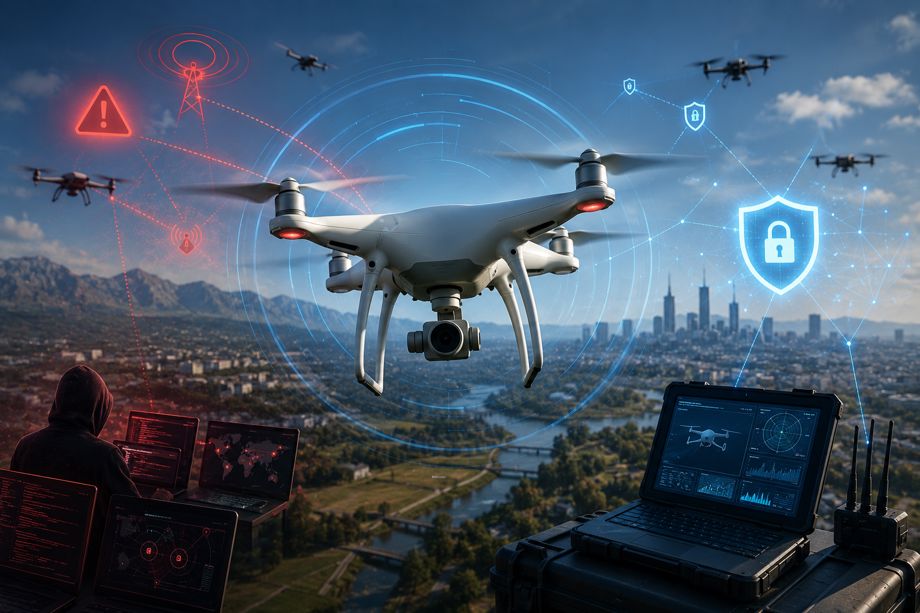
How AI is reshaping UAV cybersecurity and where it falls short
Publish Date: 2026-05-26 01:22:00
Source Domain: www.devdiscourse.com
The rapid spread of unmanned aerial vehicles (UAVs) across civilian, commercial, industrial and security operations is creating a wider target for cyberattacks, from GPS spoofing and jamming to malware and model evasion. A detailed new survey finds that AI-based defenses are advancing quickly, but not evenly, leaving key safety gaps in privacy, robustness and cross-layer protection.
The study, titled Artificial Intelligence Methods for Unmanned Aerial Vehicles Cybersecurity: A Comprehensive Survey and published in Drones, maps AI-based cybersecurity research for unmanned aerial vehicles across machine learning, deep learning, federated learning, reinforcement learning, graph neural networks and generative AI, linking each method to UAV attack types, system layers and protected security properties.
AI becomes central to drone cyber defense as attack surfaces expand
UAVs have moved far beyond their early military role and are now used in surveillance, logistics, agriculture, disaster response, urban monitoring and industrial operations. Their growing autonomy, wireless connectivity and dependence on satellite navigation have made them useful in high-value missions, but also vulnerable to cyber-physical attacks that can disrupt flight, steal data or manipulate control systems.
UAVs face threats across a layered operational stack that includes the physical layer, communication layer, navigation layer, control layer and application layer. Attacks can target radio links, sensors, actuators, GPS navigation, command channels, onboard software and AI modules. The risks include RF jamming, sensor manipulation, GPS spoofing, distributed denial-of-service attacks, man-in-the-middle attacks, malicious message injection, command injection, malware, data poisoning and model evasion.
Traditional defenses, including cryptographic tools and conventional intrusion detection systems, remain important but are increasingly strained by adaptive attacks. UAVs often…