The network watching the world’s oceans is under pressure – just when it’s needed most
The network watching the world’s oceans is under pressure – just when it’s needed most
Publish Date: 2026-05-22 14:43:00
Source Domain: theconversation.com
Increasingly, the world’s oceans are telling us our climate system may be changing faster and more dramatically than expected.
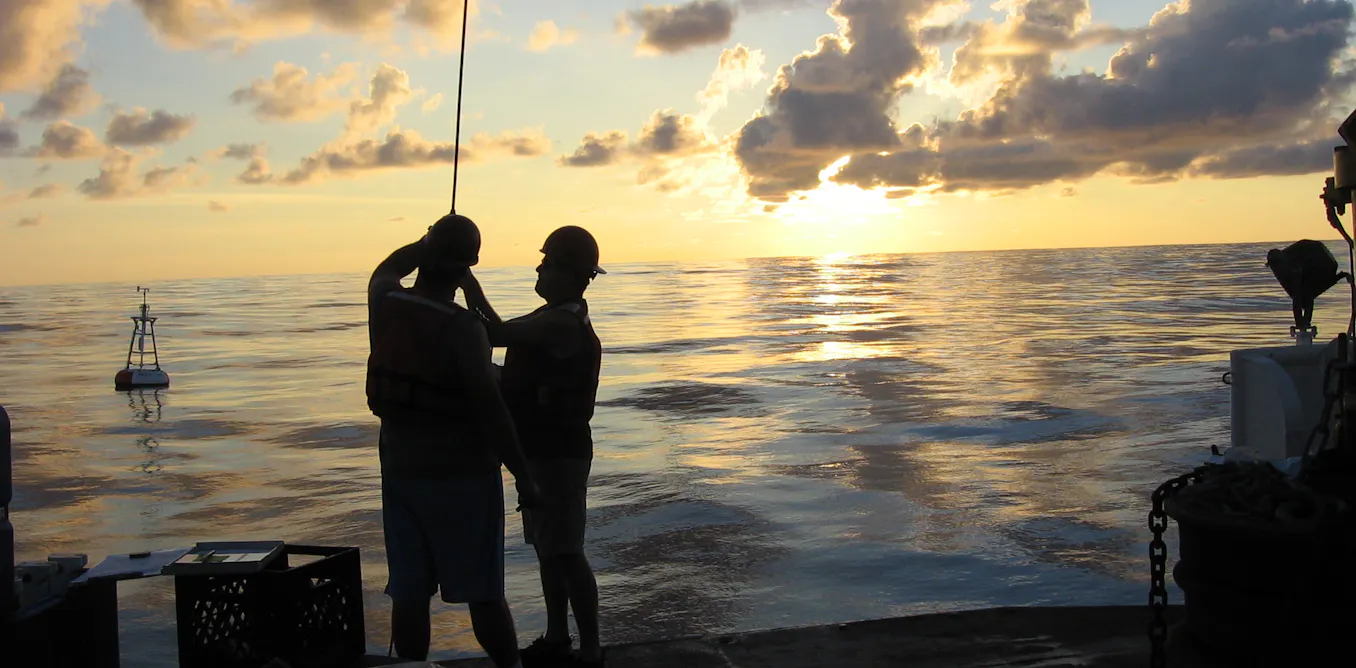
These new insights are made using a vast global network of instruments – from drifting floats and moored buoys to research vessels and underwater gliders – that quietly and continuously feed data to scientists.
Known as the Global Ocean Observing System (GOOS), it provides the fine-grained data that scientists need to detect changes, test climate models and refine projections of future risk.
But now there is rising concern this system itself is at risk – just when the world needs it most.
The hidden system behind modern forecasting
The GOOS is often described as a form of climate monitoring – but it is much more than that. It can best be understood as a network of complementary observing systems, each designed to capture different parts of the ocean in different ways.
Some 4000 autonomous Argo robotic floats sink every ten days down to 2000m depth, before rising to the surface to transmit temperature and salinity profiles to ground stations via satellite.
Underwater gliders target eddies, coastal currents and continental margins where floats cannot go. Elephant seals fitted with sensors collect data beneath polar sea ice in regions no other instrument can easily reach.
An elephant seal fitted with a sophisticated data collection device. The instruments drop off in moulting season.
C McMahon/IMOS, CC BY-NC-ND
Each of these platforms answer questions the others cannot. And ocean observations collected by them now underpin many of the forecasting systems that modern societies rely on every day.
That includes the numerical weather models used to generate daily forecasts, which continuously ingest ocean data to predict evolving weather conditions, as well as newer artificial intelligence-based forecasting systems.
The same is true for…