The impact of trust in AI on digital innovation examining the moderation of intellectual capital and task characteristics
https://www.nature.com/articles/s41598-026-46103-x
Publish Date: 2026-05-18 19:27:00
Source Domain: www.nature.com
Trust in AI
In recent years, the focus of trust research has expanded from interpersonal trust and inter-firm trust to trust in technology27. In the field of AI, trust is a core factor explaining agents’ adoption of AI recommendations in judge-advisor systems and algorithmic management9. Focusing on AI-based innovation, this study defines trust in AI as managers’ belief that AI-based decision support will not act in ways that harm their interests, reflecting a willingness to accept vulnerability and risk28. Following the classical theory of organizational trust, trust in AI comprises three dimensions: ability, benevolence, and integrity29. Specifically, ability refers to AI’s competence in supporting complex innovation tasks; benevolence captures an orientation toward enhancing human decision-making and organizational well-being; and integrity reflects consistency, transparency, and adherence to established norms29. Accordingly, we conceptualize the trustor as AI-savvy senior innovation managers, and the trustee as the AI-based decision support system.
Trust in AI and digital innovation
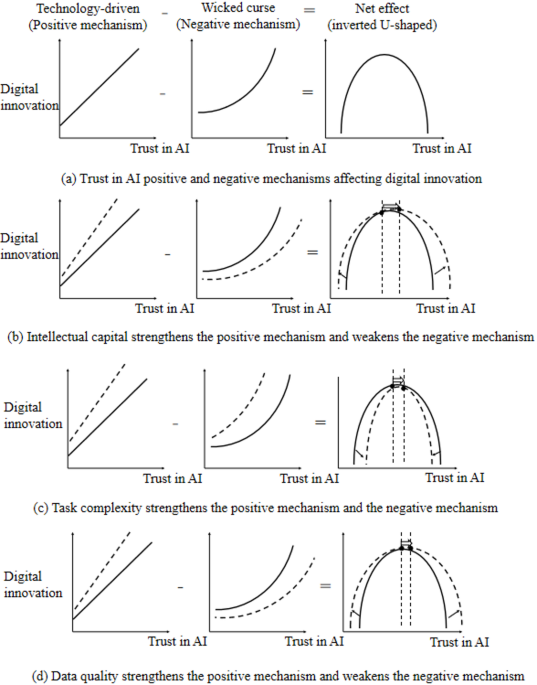
Anchored in IPT, this study views human-AI collaborative innovation as a sequence of information processing activities, from gathering and interpretation to verification, synthesis, decision-making, and iteration30. This stage logic motivates two mechanisms that explain why trust in AI relates to digital innovation in an inverted U-shaped manner.
“Technology-driven” mechanism
The technology-driven mechanism posits that trust in AI improves efficiency across the information processing stages and accelerates digital innovation. Digital innovation depends on the fit between information processing capacity and environmental demands31. Trust enables AI to automate routine processing, improving efficiency and decision precision19. Owing to its capacity to process large, diverse data at low cost and high speed, AI can transcend human cognitive constraints in cross-domain…