Study reveals hidden damage in stony corals using 3D imaging and AI
Study reveals hidden damage in stony corals using 3D imaging and AI
Publish Date: 2026-05-08 06:40:00
Source Domain: www.theinvadingsea.com
By Gisele Galoustian, FAU News Desk
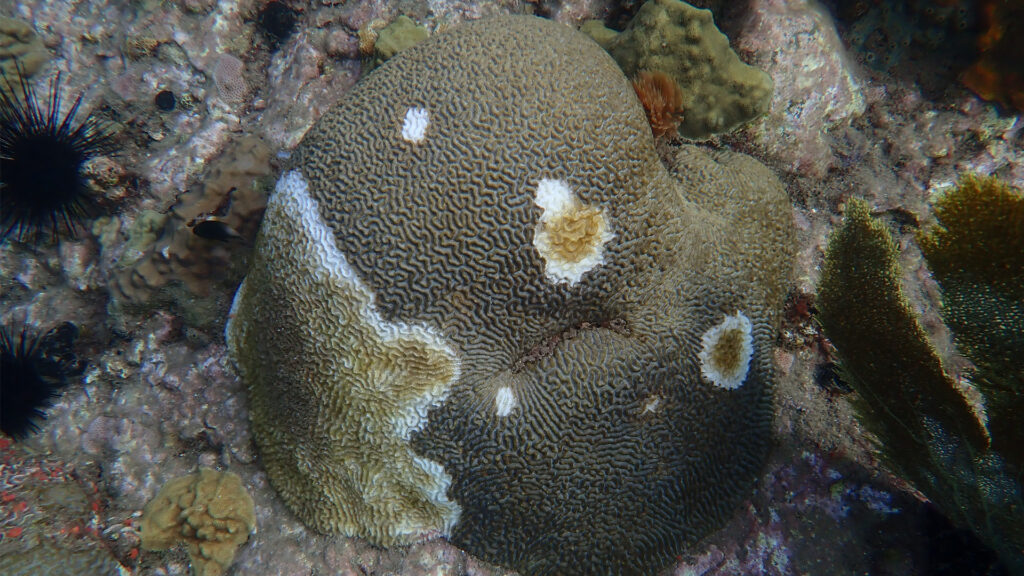
Florida’s coral reefs are under siege. Since 2014, stony coral tissue loss disease (SCTLD) has spread rapidly across the Florida Reef Tract and Caribbean, killing vast numbers of reef-building corals and leaving behind dead skeletons where once-thriving reefs supported diverse marine life. Despite the severity of the crisis, little is known about how these diseases affect the microscopic structure of coral skeletons – the pores, densities and thicknesses that give reefs their strength and resilience.
Studying these tiny features has long been a challenge. Traditional methods are slow and often miss subtle structural changes.
A micro-CT of healthy coral (M. cavernosa). (FAU)
To address this challenge, Florida Atlantic University researchers turned to X-ray microcomputed tomography (micro-CT). The technique generates detailed 3D reconstructions down to microscopic pores, which reveal internal skeletal features, including porosity, thickness and structural orientation, in a non-destructive way. Housed in the FAU High School Owls Imaging Lab, the micro-CT was ideal for imaging corals, whose high mineral content provides strong X-ray contrast.
Researchers combined micro-CT imaging with deep learning-based image segmentation, using convolutional neural networks (CNNs), a form of artificial intelligence, to automatically distinguish coral skeletons from pore spaces. By analyzing images through patterns and features, this approach is faster and more accurate than traditional manual methods.
“Micro-CT gives us a window into the coral skeleton in a way that’s never been possible before,” said Alejandra Coronel-Zegarra, first author and a Ph.D. candidate in the Department of Chemistry and Biochemistry within FAU’s Charles E. Schmidt College of Science who won the 2025 Microscopy and Microanalysis Student Award for her research on SCTLD. “By combining it with deep learning, we can…