Clinical Alarm Management Market Poised for 11.20% CAGR Growth
Clinical Alarm Management Market Poised for 11.20% CAGR Growth
https://www.openpr.com/news/4501402/clinical-alarm-management-market-poised-for-11-20-cagr-growth
Publish Date: 2026-05-05 07:27:00
Source Domain: www.openpr.com
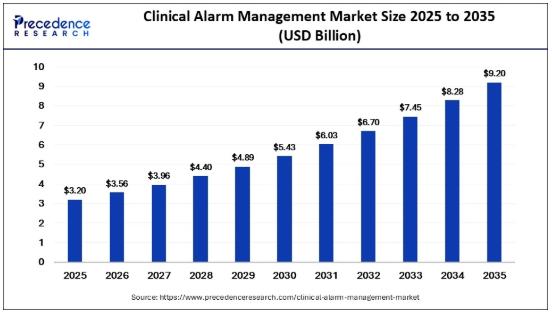
According to Precedence Research, the global clinical alarm management market size was estimated at USD 3.20 billion in 2025 and is projected to surge from USD 3.56 billion in 2026 to approximately USD 9.20 billion by 2035, registering a robust CAGR of 11.20% from 2026 to 2035.
The surge in demand is primarily driven by the growing adoption of healthcare IT infrastructure, increasing prevalence of chronic diseases, and a significant rise in non-actionable clinical alarms in hospitals. As healthcare providers strive to improve response times and streamline clinical workflows, advanced alarm management systems are rapidly gaining traction worldwide.
Where Data Meets Strategic Clarity 📥 View Sample Pages of the Complete Report 👉 https://www.precedenceresearch.com/sample/8368
How is AI Transforming Clinical Alarm Management Systems?
Artificial intelligence is redefining how healthcare systems manage clinical alarms. In traditional hospital environments, a significant portion of alarms are non-actionable, contributing to alarm fatigue and delayed responses. AI-powered systems analyze vast volumes of patient data in real time, filtering out false alerts and ensuring only critical notifications reach clinicians.
Moreover, AI enables personalized alarm thresholds by learning patient-specific patterns. This not only enhances detection accuracy but also ensures timely intervention in critical cases. As a result, AI-driven alarm systems are becoming indispensable in improving patient outcomes and optimizing clinical workflows.
Clinical Alarm Management Market Key Growth Drivers
The primary driver of market growth is the increasing focus on patient safety and the urgent need to address alarm fatigue caused by excessive non-actionable alerts. Hospitals generate thousands of alarms daily, many of which are false or clinically insignificant. Advanced alarm management systems help prioritize critical alerts, ensuring timely…