Economic evaluation of artificial intelligence for cancer detection in the UK breast screening programme
https://www.nature.com/articles/s41416-026-03465-3
Publish Date: 2026-05-02 16:51:00
Source Domain: www.nature.com
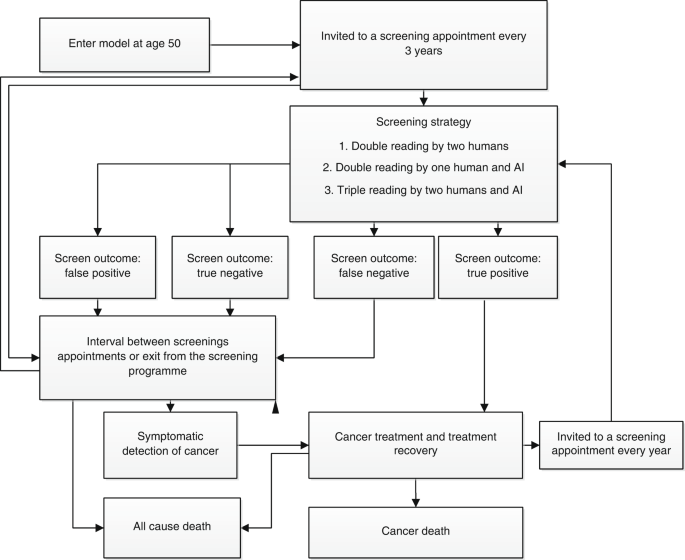
We constructed a de novo discrete-event simulation (DES) model to evaluate the cost-effectiveness of integrating AI for cancer detection in the NHS Breast Screening Programme. The model replicates the UK screening pathway, capturing individual screening and treatment trajectories along with the immediate and long-term benefits of earlier cancer detection, such as cancer stage shift, improved survival, reduced recurrence, and lower treatment costs. The evaluation followed National Institute for Health and Care Excellence (NICE) guidance (2025) [18] and the CHEERS-AI checklist (2024) [19], was conducted from the NHS and personal social services perspective, and considered lifetime costs and outcomes. The model was built in R (version 4.2.2). The model code is available upon request to the corresponding author and may be accessed only for academic and reproducibility purposes with approval from the study’s funder. All model assumptions, technical methods, and data sources are detailed in the appendix.
Four screening strategies were compared based on the configurations evaluated in the ScreenTrustCAD trial. Standard double reading by two radiologists, double reading by one radiologist plus AI, single reading by AI alone, and triple reading by two radiologists plus AI. The AI system used was Insight MMG version 1.1.6 (Lunit, South Korea), with technical details available in the original trial publication [17]. The DES model design was chosen for its ability to represent individual histories and timing of key events, capturing the complexity of population-based breast cancer screening pathways.
Model structure and overview
Figure 1 shows the model structure, detailing the sequence of clinical events and potential pathways from the initiation of screening to cancer detection and eventual mortality. The simulated cohort represents women eligible for routine screening. At the model’s start, each individual is assigned an age at death for other causes than breast cancer…