Respiratory Syncytial Virus (RSV) Diagnostic Market Size
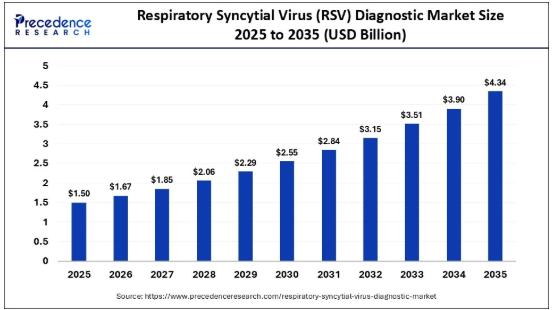
Respiratory Syncytial Virus (RSV) Diagnostic Market Size
https://www.openpr.com/news/4481738/respiratory-syncytial-virus-rsv-diagnostic-market-size
Publish Date: 2026-04-21 05:53:00
Source Domain: www.openpr.com
According to Precedence Research, the global Respiratory Syncytial Virus (RSV) diagnostic market size was valued at USD 1.50 billion in 2025 and is predicted to reach around USD 4.34 billion by 2035, expanding at a CAGR of 11.20% from 2026 to 2035. This growth is primarily driven by an increasing prevalence of respiratory infections, a growing neonatal population, and the significant demand for in-vitro diagnostics along with point-of-care services.
The rapid advancement in diagnostic tools has greatly enhanced the speed and precision of RSV detection, positioning companies in this sector for promising opportunities.
Where Data Meets Strategic Clarity 📥 View Sample Pages of the Complete Report 👉 https://www.precedenceresearch.com/sample/8321
Respiratory Syncytial Virus (RSV) Diagnostic Market Size and Forecasts
• Market size in 2025: USD 1.50 Billion
• Market size in 2026: USD 1.67 Billion
• Market size by 2035: USD 4.34 Billion
• CAGR: 11.20% (2026-2035)
• Forecast period: 2026-2035
• Base year: 2025
How is Artificial Intelligence (AI) Transforming the RSV Diagnostic Market?
AI has started playing an integral role in transforming the way RSV diagnostics are performed. By utilizing algorithms to analyze trends in weather, hospital statistics, and epidemiological data, AI is allowing healthcare systems to predict RSV outbreaks before they fully manifest. Furthermore, AI enhances the interpretation of multiplex test results, helping differentiate between RSV, influenza, and COVID-19 infections. This has led to a more proactive diagnostic approach, assisting clinicians in making more informed decisions.
AI’s ability to predict RSV outbreaks also contributes to better resource management in healthcare systems. Through AI-driven insights, testing volumes can be preemptively adjusted, improving efficiency and ensuring that diagnostic resources are deployed appropriately.
🔗 What’s Fueling the Next Wave of…