Cadets focus on science, technology, engineering and mathematics • United States Air Force Academy
Cadets focus on science, technology, engineering and mathematics • United States Air Force Academy
https://www.usafa.edu/cadets-focus-on-science-technology-engineering-and-mathematics/
Publish Date: 2026-03-30 12:49:00
Source Domain: www.usafa.edu
Cadets focus on science, technology, engineering and mathematics
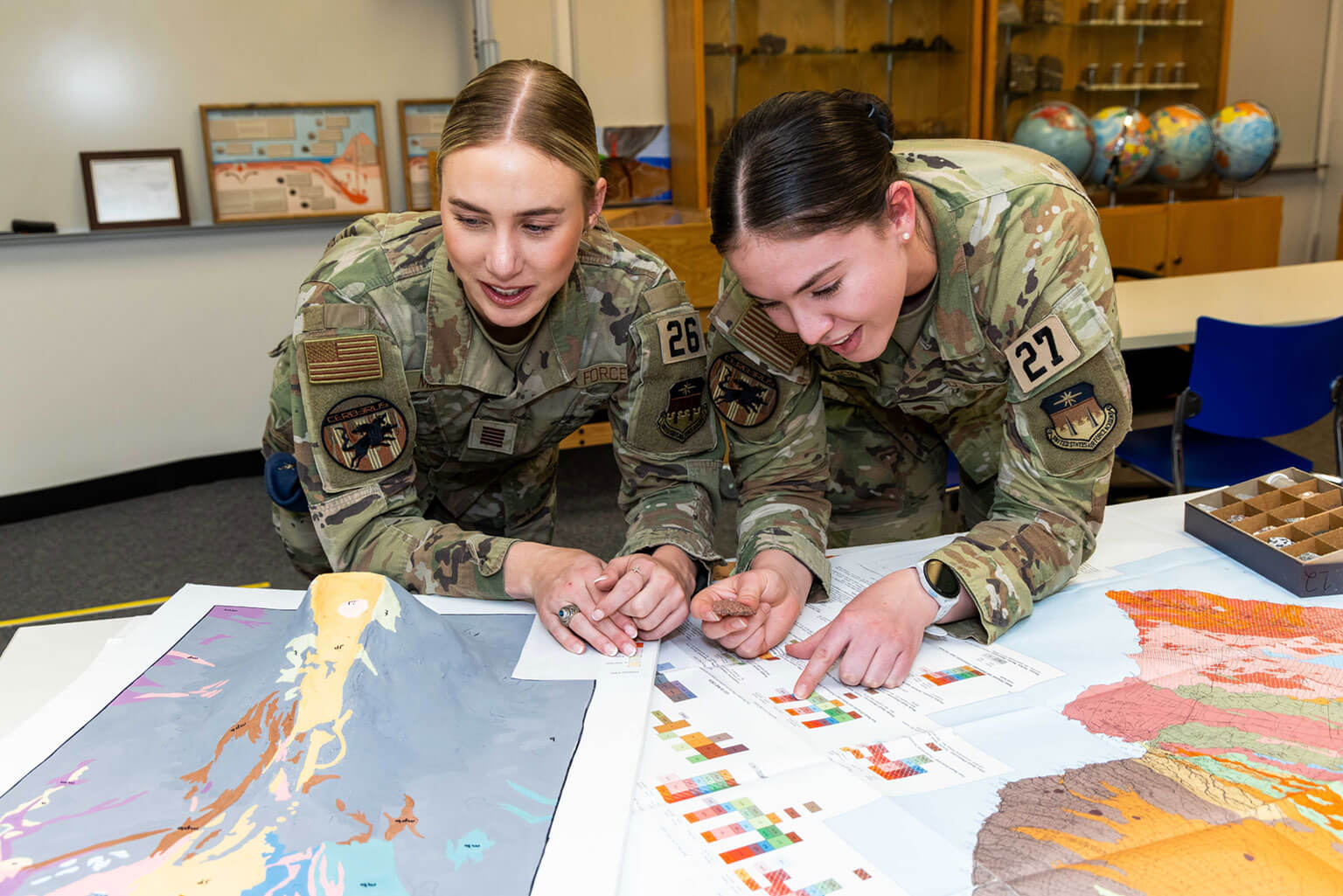
Cadet 1st Class Lauren Mirande, left, and Cadet 2nd Class Abigail Anderson, right, learn about volcanic rock types in the Geospatial Science Laboratory, at the U.S. Air Force Academy, Colo., March 19, 2026. Mirande and Anderson are learning to interpret and analyze data for future operations. (U.S. Air Force photo by Trevor Cokley)
By Harry Lundy
U.S. Air Force Academy Strategic Communications
U.S. AIR FORCE ACADEMY, Colo. – The U.S. Air Force Academy is a leading science, technology, engineering and mathematics institution, frequently ranked among the nation’s top STEM programs. Cadets develop analytical thinking, creativity and problem-solving skills to operate in a rapidly evolving technological environment.
Graduates must be agile thinkers and creative problem-solvers who can meet future challenges in the air, space and cyberspace domains. The Academy provides a rigorous academic foundation to support Air Force and Space Force missions.
Chemistry
Chemistry majors like Cadet 1st Class Emily Adair study concepts that form the foundation for applications in medicine, air, space and rocket propulsion and nuclear and biological treaty compliance testing. Adair said what appeals to her most is how chemistry explains the world at the molecular level.
“The most significant project I have worked on is a small molecular sensor,” Adair said. The sensor shows promise as a cost-effective method for detecting chemical warfare agents.
“My goal is that this work will serve as a foundation for future cadets to incorporate its use operationally, providing better protection for military personnel through faster detection,” she said.
Adair has learned to view setbacks as opportunities for adjustment, rather than dead ends, using them to move forward when experiments yield unexpected results.
“In chemistry, we troubleshoot problems by making adjustments,” Adair said. “I will carry this…
.jpg "EBU unveils nominees for Technology and Innovation Awards 2026")