Synthetic Medical Data: The Privacy-Safe Fuel Powering
Synthetic Medical Data: The Privacy-Safe Fuel Powering
https://www.openpr.com/news/4423380/synthetic-medical-data-the-privacy-safe-fuel-powering
Publish Date: 2026-03-13 03:44:00
Source Domain: www.openpr.com
Synthetic medical data lets AI developers train smarter models without ever touching real patient records.
Healthcare AI has a problem that doesn’t get talked about enough. Building the algorithms that could transform diagnostics, drug discovery, and clinical decision-making requires enormous amounts of patient data. But patient data is among the most tightly protected information that exists, hedged in by privacy regulations, institutional policies, and the entirely reasonable expectation that what happens in a hospital stays private. For a long time, these two realities just sat in uncomfortable tension with each other.
Download Sample Report Here : https://www.meticulousresearch.com/download-sample-report/cp_id=6308
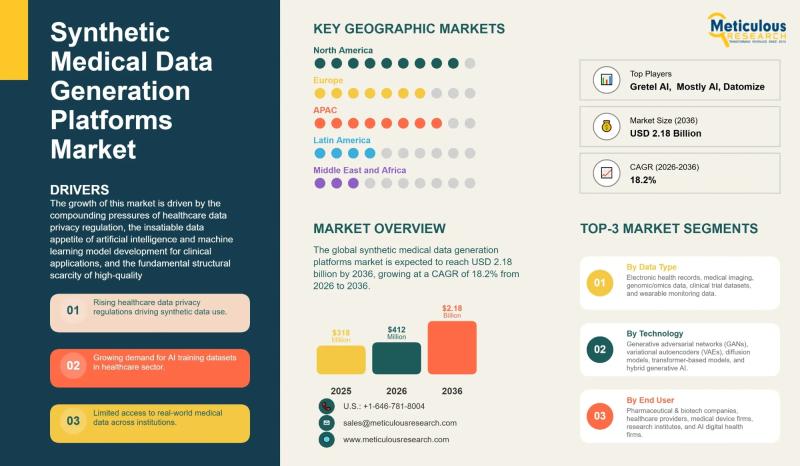
Synthetic medical data generation is how the industry is starting to resolve that tension. These platforms create artificial patient datasets that are statistically indistinguishable from real clinical data but contain no actual patient information whatsoever. The global market for these platforms was valued at $318 million in 2025 and is projected to reach $2.18 billion by 2036, growing at a CAGR of 18.2%. That growth rate reflects just how urgently healthcare organizations, pharmaceutical companies, and AI developers need a better solution to the data access problem – and how much confidence is building that synthetic data can actually deliver one.
What Are Synthetic Medical Data Generation Platforms
The basic idea sounds almost too good to be true: software that generates fake patient records that are so statistically faithful to real ones that machine learning models trained on them perform just as well as models trained on the real thing. But that’s genuinely what these platforms do, and the technology behind them is sophisticated. The leading approach uses generative adversarial networks – a type of AI architecture where two neural networks essentially compete with each other, one generating synthetic records…