Edge Computing in Healthcare Market Projected to Reach USD 47.23
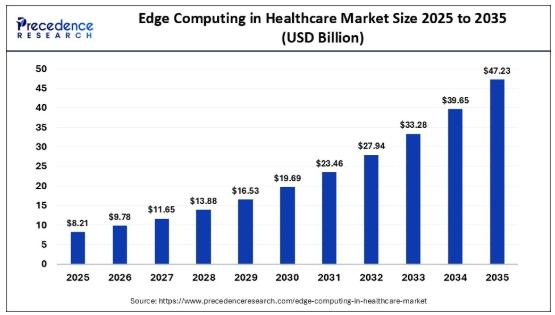
Edge Computing in Healthcare Market Projected to Reach USD 47.23
https://www.openpr.com/news/4423884/edge-computing-in-healthcare-market-projected-to-reach-usd-47-23
Publish Date: 2026-03-13 08:26:00
Source Domain: www.openpr.com
According to Precedence Research, the global Edge Computing in Healthcare market size surpassed USD 8.21 billion in 2025 and is poised to surge to approximately USD 47.23 billion by 2035. This dramatic growth reflects an impressive compound annual growth rate (CAGR) of 19.12% from 2026 to 2035, primarily driven by the increasing adoption of IoT medical devices, the demand for real-time data processing, and the expansion of 5G networks in the healthcare sector.
Edge computing is revolutionizing the healthcare industry by improving data processing capabilities, enhancing patient monitoring, ensuring data privacy, and facilitating critical, real-time decision-making.
Where Data Meets Strategic Clarity 📥 View Sample Pages of the Complete Report 👉https://www.precedenceresearch.com/sample/8125
The Role of Artificial Intelligence in Edge Computing for Healthcare
AI is at the heart of the transformation brought about by edge computing in healthcare. It assists robotic systems, such as the da Vinci Surgical System, by processing sensor data in real-time, enhancing precision and safety during surgeries. Additionally, AI algorithms support the analysis of medical images directly on the device, reducing the need to transmit large files to the cloud, ensuring both faster diagnosis and enhanced data privacy.
Market Growth Factors
➢ Real-Time Data Processing: Edge computing allows patient data to be processed near the source, reducing latency and enabling faster clinical decisions in life-critical situations.
➢ Connected Medical Devices: The increasing integration of smart devices in healthcare, such as wearables and sensors, necessitates local data processing to manage large volumes of data efficiently.
➢ Data Privacy: Edge computing reduces the transmission of sensitive health data, ensuring higher security and privacy for patients.
➢ 5G Network Expansion: With 5G offering ultra-low latency, healthcare applications such as remote…