Hardware Acceleration Market Projected to Grow from USD 4.85
Hardware Acceleration Market Projected to Grow from USD 4.85
https://www.openpr.com/news/4420656/hardware-acceleration-market-projected-to-grow-from-usd-4-85
Publish Date: 2026-03-11 08:35:00
Source Domain: www.openpr.com
The global hardware acceleration market is experiencing exponential growth, driven by the increasing adoption of artificial intelligence (AI), cloud services, and advanced analytics.
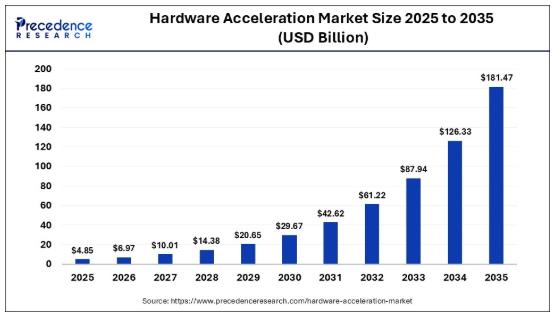
According to Precedence Research, the global hardware acceleration market size will grow from USD 4.85 billion in 2025 to nearly USD 181.47 billion by 2035, expanding at a strong CAGR of 43.65% from 2026 to 2035. The surge in demand for high-performance processing solutions across industries makes hardware acceleration a cornerstone for enabling faster, more efficient computing. This press release delves into the key market insights, trends, and dynamics that will shape the industry’s future.
Where Data Meets Strategic Clarity 📥 View Sample Pages of the Complete Report 👉 https://www.precedenceresearch.com/sample/8070
Market Size and Forecasts
🔹 Market size in 2025: USD 4.85 Billion
🔹 Market size in 2026: USD 6.97 Billion
🔹 Market size by 2035: USD 181.47 Billion
🔹 CAGR: 43.65% (2026-2035)
🔹 Forecast period: 2026-2035
🔹 Base year: 2025
What is Hardware Acceleration?
Hardware acceleration involves offloading specific tasks, typically handled by a CPU, to specialized processors such as GPUs, AI accelerators, and FPGAs (Field-Programmable Gate Arrays). This results in significant performance enhancements for resource-intensive tasks, from real-time data analytics to complex AI model training. As industries embrace digital transformation, this technology is becoming indispensable, particularly in sectors like healthcare, automotive, finance, and telecommunications.
🔗 What’s Fueling the Next Wave of Growth? 👉 https://www.precedenceresearch.com/hardware-acceleration-market
The Role of AI in the Hardware Acceleration Market
AI is revolutionizing industries by enabling faster decision-making processes and improved operational efficiency. As AI workloads grow in complexity, traditional CPU-based processing is no longer…