Board-Level Metrics for Measuring AI Accountability
Board-Level Metrics for Measuring AI Accountability
Publish Date: 2026-02-26 03:52:00
Source Domain: www.eccouncil.org
Boards are being asked to oversee artificial intelligence (AI) without the signals they need to do it well.
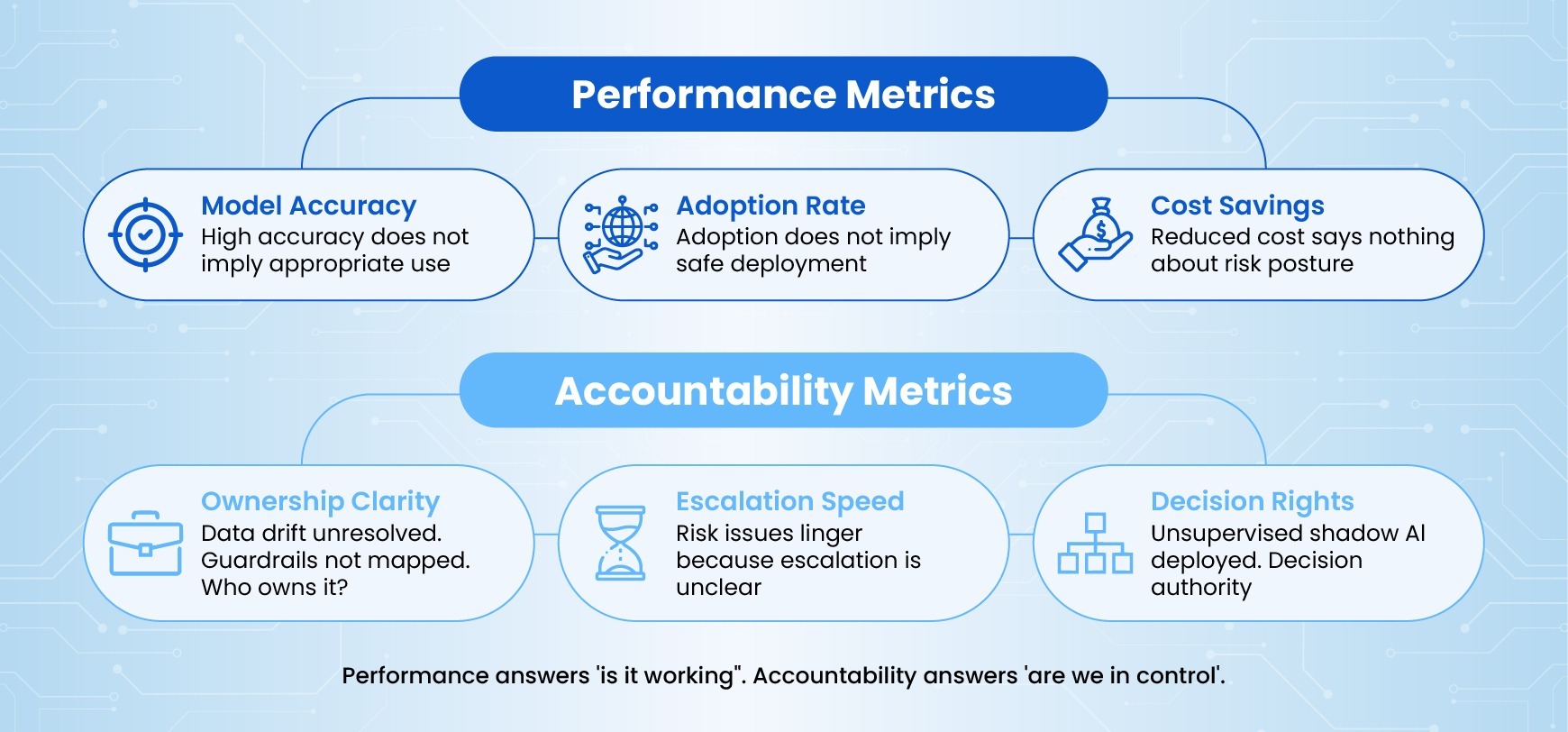
Most AI reporting still focuses on performance factors, including accuracy, adoption, and cost savings. These metrics matter operationally, but they do not answer the questions boards are responsible for answering. That includes who owns the risk, who makes decisions when things go wrong, how fast issues surface, and whether AI initiatives remain aligned to approved intent.
This is an accountability problem, not a technology problem.
This article explains what board-level AI accountability metrics look like, why traditional IT and digital metrics fail, and how boards can use a small number of well-chosen indicators to improve oversight without slowing execution.
The Boards’ Real AI Problem Is Accountability, Not Performance
Boards do not manage models. They govern risk, capital, and reputation.
When AI failures occur, the root cause is rarely a poorly tuned algorithm. It is unclear ownership, diffused decision rights, delayed escalation, or governance that exists on paper but not in practice.
Performance metrics tell boards whether systems are working. Accountability metrics tell boards whether the organization is in control.
Without accountability signals, boards are forced into reactive oversight. They learn about AI issues after harm occurs. At that point, intervention is expensive, and credibility is damaged.
When AI projects stall, it is almost never because the underlying models cannot be tuned. It is because the organization cannot clearly say who owns which…