How a poet uses AI to write and why her work is now at MoMA
How a poet uses AI to write and why her work is now at MoMA
Publish Date: 2026-02-23 07:00:00
Source Domain: www.scientificamerican.com
February 23, 2026
4 min read
Add Us On GoogleAdd SciAm
Poetry was humanity’s first language technology. AI is the next
Sasha Stiles turned GPT-2 experiments into a self-writing poem at a Museum of Modern Art installation—and a new way to think about text-generating AI optimization
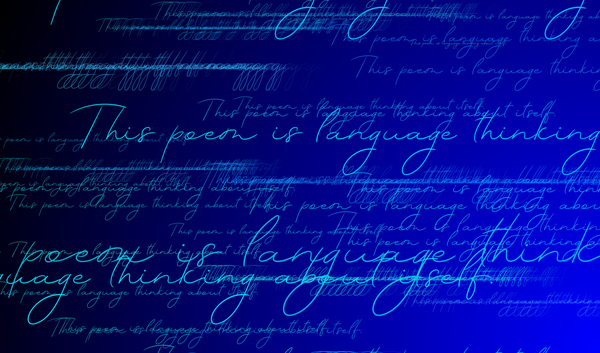
A photograph of a layered, animated screen still from A LIVING POEM, where lines of text unfurl and overlap in real time as part of Sasha Stiles’ AI-assisted poetry performance.
Poetry and artificial intelligence can appear as opposites—one deeply human; the other cold and mechanical. Sasha Stiles sees them as expressions of the same impulse. Poetry, the Kalmyk- American poet argues, is “one of our most ancient and enduring technologies,” a system of meter and rhyme invented to store vital information. She views AI as its natural heir.
Stiles’s path to AI began with literature, not code. But science was never distant: Her parents are documentary filmmakers who worked with Carl Sagan on the original Cosmos series, and she grew up traveling with them as they interviewed scientists and philosophers. She came of age with the Internet and sensed how it shaped the way she thought and wrote. When she encountered the technology underpinning modern AI in 2019, she didn’t want to just write about it—she wanted to write with it.
Scientific American spoke to Stiles about why language may be the defining medium of the AI moment.
On supporting science journalism
If you’re enjoying this article, consider supporting our award-winning journalism by subscribing. By purchasing a subscription you are helping to ensure the future of impactful stories about the discoveries and ideas shaping our world today.
[An edited transcript of the interview follows.]
How did you end up creating art at the intersection of poetry and AI?
In 2017 I read about the transformer-based architectures that drive natural language processing, and something clicked. That’s the…