Where Physical Reality Meets Artificial Intelligence
Where Physical Reality Meets Artificial Intelligence
https://reports.tiger-research.com/p/iotex-where-physical-reality-meets-eng
Publish Date: 2026-02-19 08:02:00
Source Domain: reports.tiger-research.com
Is there anything AI cannot do? Step one foot outside a closed system, and it breaks down surprisingly fast. IoTeX set out to solve exactly that weakness, and has begun its transition into an AI platform.
-
AI now performs across most fields, but fails the moment it relies on fragmented, unverifiable external data.
-
IoTeX has spent eight years building the unified infrastructure to close that gap, transitioning into a platform that supplies real-world data at scale through a three-layer stack of ioID, Quicksilver, and Realms.
-
Trio is the first commercial product built on that stack, converting infrastructure into direct SaaS revenue through enterprise subscriptions.
-
The 2026 investment thesis hinges entirely on execution: whether Trio can secure enterprise contracts and whether the Real-World AI Foundry can demonstrate production-grade model performance.
In 2025, AI has exceeded expectations across nearly every field.
OpenAI’s reasoning model achieved gold-medal-level scores at the International Mathematical Olympiad (IMO). GitHub Copilot now generates an average of 46% of developer code directly. AI agents independently handle email management, scheduling, and workflow automation.
“What can AI do?” is no longer the right question.
Inside a closed system, AI is already smart enough. Siemens, GE, and similar firms already run full sensor-to-model pipelines in-house.
The problem starts the moment AI crosses that boundary.
Consider autonomous vehicles. Onboard sensors alone can enable self-driving. But a precise system requires external data including traffic signals, pedestrian detection sensors, and weather stations. Only when thousands of such sources connect in real time does a truly reliable AV system become possible. Yet these sources are operated by different agencies, use inconsistent formats, and share no common standard for verifying data origin.
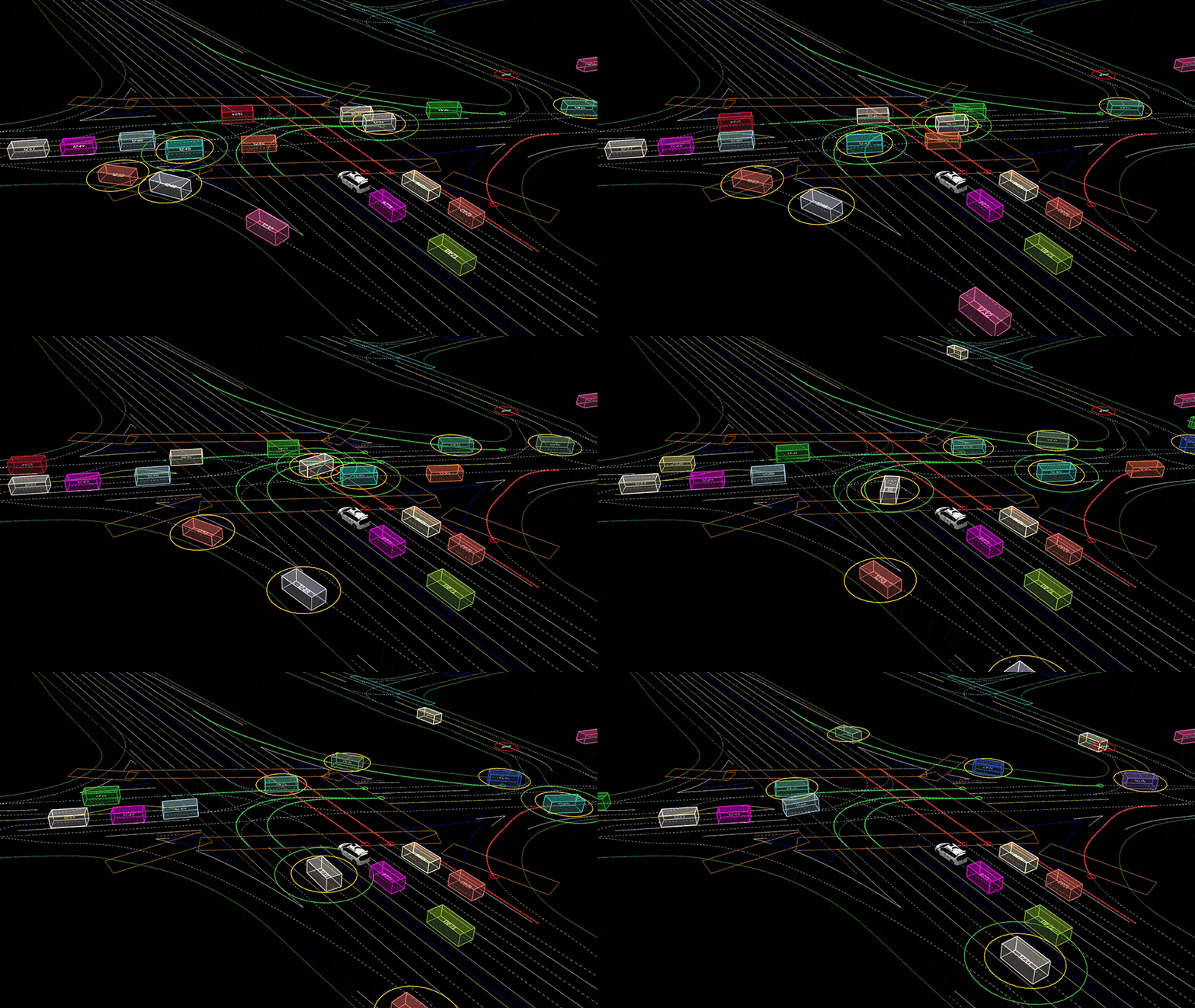
Companies like Waymo and Cruise have already taken on this challenge, building systems…