Hashgraph & Truesense file patent for privacy ID system
Hashgraph & Truesense file patent for privacy ID system
https://securitybrief.co.uk/story/hashgraph-truesense-file-patent-for-privacy-id-system
Publish Date: 2026-06-19 03:28:00
Source Domain: securitybrief.co.uk
The Hashgraph Group and Truesense have filed a European patent application for a digital identity system called Continuous Identity Trust Infrastructure.
The system is designed to verify that a person was physically present at a specific place and time without disclosing personal data.
According to the companies, the filing covers more than 44 European countries through the European Patent Office. They added that the invention is also being prepared for submission to the United States Patent and Trademark Office.
CITI combines ultra-wideband sensing, decentralised digital identity and zero-knowledge proof cryptography to create a verifiable credential that a third party can check without revealing the individual’s identity or location.
The process begins with ultra-wideband (UWB) detection to determine whether a person is present within a defined area. The system uses radar-mode sensing to identify signs such as breathing and heartbeat, alongside an on-device machine learning model intended to distinguish human motion.
That physical presence event is then linked to a decentralised identifier stored in a digital identity wallet. A credential is issued with a timestamp, zone identifier and cryptographic reference, while a record is anchored on the Hedera distributed ledger.
The proposed system is framed as a response to tighter European rules on digital identity, cybersecurity and audit trails. The companies pointed to alignment with the European Blockchain Services Infrastructure, W3C standards for decentralised identifiers and verifiable credentials, the NIS2 Directive, eIDAS2 and the EU Digital Identity Wallet framework.
They also linked the project to the EU’s Digital Product Passport and Ecodesign for Sustainable Products Regulation agenda, which is expected to expand requirements for traceable digital records across sectors.
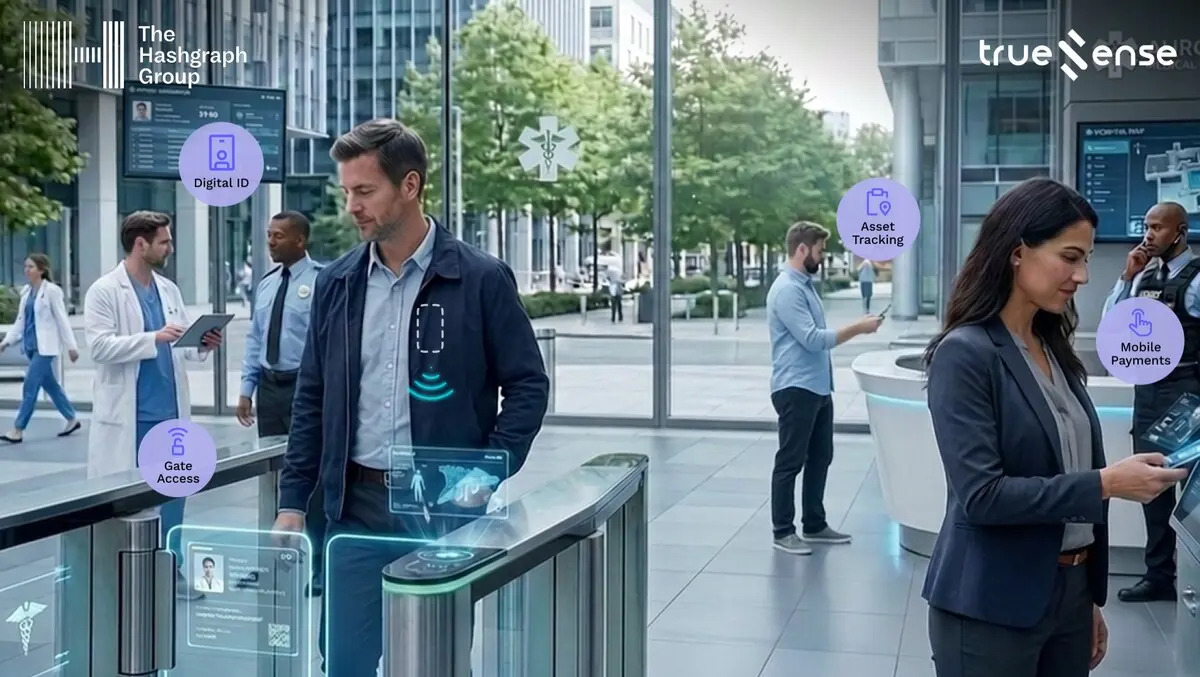
Use cases
The companies said the technology could be used in financial services, healthcare, transport,…