Receptiveness of physicians towards artificial intelligence-driven drug prescription: a nationwide survey
https://www.nature.com/articles/s44401-026-00101-3
Publish Date: 2026-06-07 21:28:00
Source Domain: www.nature.com
Stratified sampling of participants
Survey was conducted during 16 May 2025–29 September 2025 in 14 provincial-level administrative divisions (“provinces”) of China. Per capita gross domestic product (GDP) in 2024 was 15,000 US dollars ($) in 5 of the surveyed provinces (Jiangsu, Fujian, Zhejiang, Tianjin, Inner Mongolia), $10,001 –15,000 in 5 provinces (Anhui, Liaoning, Sichuan, Tibet, Shanxi), and $7001–10,000 in 4 (Qinghai, Henan, Hebei, Guangxi)11.
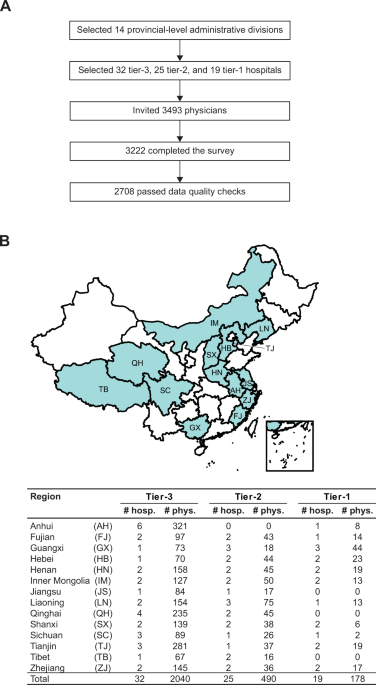
3493 physicians, including 2632 drawn from 32 tier-3 (highest-level) hospitals, 614 from 25 tier-2 hospitals, and 247 from 19 tier-1 (lowest-level) hospitals, participated in the survey (Fig. 1A; “Methods”). The surveyed hospitals are listed in Supplementary Table 1. 271 (7.8%) participants did not complete the survey.
Fig. 1: A stratified sample of 2708 physicians.The alternative text for this image may have been generated using AI.
A Work flow for stratified sampling and data quality control. B Distribution of the 2708 respondents whose returned questionnaires passed data quality checks. “hosp.” and “phys.” stand for hospital(s) and physician(s), respectively.
Among the 3222 (92.2% of 3493) participants who completed the survey, median time to completion was 7 min (IQR, 4–12). To ensure data quality, we excluded data from 278 (8.6% of 3222) physicians who completed in 1A).
The final dataset includes 2708 physicians (Fig. 1B). 1640 (60.6%) and 1068 (39.4%) are internists and surgeons, respectively. 980 (36.2%) are from the most economically developed provinces (Jiangsu, Fujian, Zhejiang, Tianjin, Inner Mongolia) in our sample, 954 (35.2%) are from moderately developed provinces (Anhui, Liaoning, Sichuan, Tibet, Shanxi), and 774 (28.6%) from the least developed provinces (Qinghai, Henan, Hebei, Guangxi). 2040 (75.3%), 490 (18.1%), and 178 (6.6%) respondents are from tier-3, -2, and -1 hospitals, respectively.
Demographics of respondents
The survey consisted of 32 questions (Q) divided into…