OpenAI secretly developing an Agentic AI smartphone to take on iPhone, Android
OpenAI secretly developing an Agentic AI smartphone to take on iPhone, Android
Publish Date: 2026-04-27 12:23:00
Source Domain: macdailynews.com
Renowned analyst Ming-Chi Kuo reports that OpenAI is partnering with MediaTek and Qualcomm on custom smartphone processors, with Luxshare as the exclusive system co-design and manufacturing partner.
Mass production is targeted for 2028.
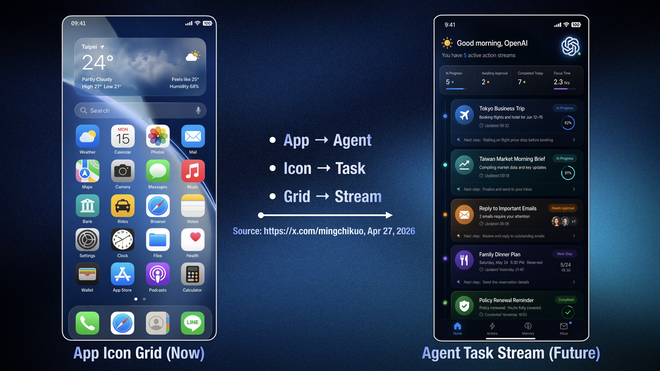
The concept: an AI Agent-first phone that ditches traditional app grids in favor of a task-oriented interface — where users simply tell the device what they need done, powered by deeply integrated on-device + cloud AI. Kuo shared a concept design (above)comparing it to today’s iPhone home screen.
Ming-Chi Kuo via X:
• Latest industry checks: OpenAI is working with MediaTek and Qualcomm to develop smartphone processors, with Luxshare as the exclusive system co-design and manufacturing partner. Mass production is expected in 2028.
• AI Agent redefines the smartphone: Users are not trying to use a pile of apps. They are trying to get tasks done and fulfill needs through the phone. This fundamentally changes how people think about smartphones. I made a smartphone interface concept design, shown [above], for comparison with today’s model, using the iPhone as an example.
• Why would OpenAI make a phone?
1. Only by fully controlling both the operating system and hardware can OpenAI deliver a comprehensive AI agent service.
2. The smartphone is the only device that captures the user’s full real-time state, which is the most important input for real-time AI agent inference.
3. Smartphones will remain the largest-scale device category for the foreseeable future.
• Tightly integrated cloud and on-device AI:
1. The phone needs to continuously understand the user’s context. Power consumption, memory hierarchy management, and basic small-model execution will be key processor design considerations.
2. More complex or compute-intensive tasks will be handled by cloud AI.
• OpenAI’s advantages lie in its consumer brand, years of accumulated user data, and leading AI models. Smartphone hardware is already highly…