Artificial intelligence and climate migration equity
Artificial intelligence and climate migration equity
https://www.nature.com/articles/s41599-026-07087-1
Publish Date: 2026-03-28 14:46:00
Source Domain: www.nature.com
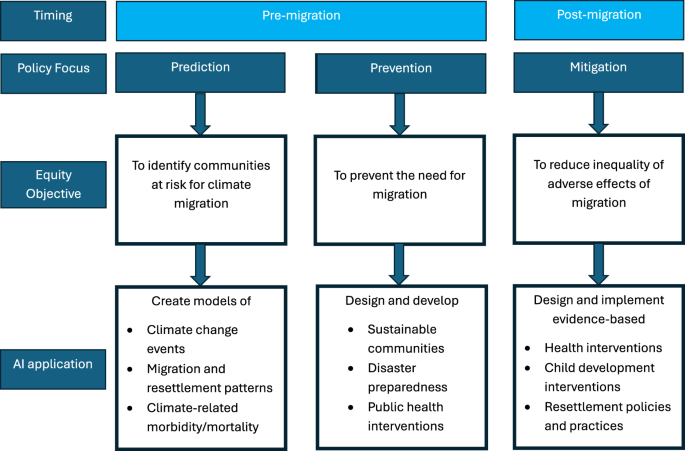
A conceptual framework of the application of AI to develop and implement policies to predict, prevent, and mitigate the consequences of climate migration in an equitable manner is illustrated in Fig. 1. Drawing upon the experience of the application of AI tools to date in the fields of health care and public health, climate and weather forecasting, and migration prediction and management, we posit that these tools may promote climate migrant equity by enhancing decision-making capacity to assist in pre-migration prediction and prevention, thereby reducing disparities in the risk of displacement in vulnerable communities, and post-migration mitigation of the social, physical and psychological consequences of displacement experienced by climate migrants.
Fig. 1
Conceptual framework of the use of AI for climate migration.
While many AI applications (e.g., ecological monitoring, disaster response systems, and health vulnerability assessments) are not unique to climate migration per se, their deployment becomes highly consequential when applied in contexts where migration is both a response to and a driver of vulnerability. This framing makes clearer how AI tools must be adapted and governed differently when used in displacement-affected regions. We have therefore structured this commentary to show not just generic AI capabilities but their specific relevance to migration-related challenges.
AI does not automatically generate equitable outcomes, but it can reshape decision-making by changing when risks become visible, whose data counts as evidence, and how early interventions are coordinated. Evidence from health and disaster contexts suggests such mechanisms can improve equity and well-being, though whether they do so in climate migration contexts remains an open empirical question.
Disaster preparedness and response
AI-driven systems already aid disaster preparedness by providing early warnings for hurricanes, wildfires, droughts, and other extreme events (Albahri et…