An AI lab says chatbots have what may be a key feature of consciousness. Are they right? And what now?
Publish Date: 2026-07-13 15:48:00
Source Domain: theconversation.com
When you interact with a large language model (LLM) – one of the systems behind chatbots such as ChatGPT and Claude – it can feel as though you are in contact with another conscious mind. But are you, really?
Some prominent scientists, such as Geoff Hinton and Richard Dawkins, claim you are. But most experts remain sceptical, arguing that the impressive cognitive capacities of LLMs occur in the absence of consciousness.
Last week researchers at Anthropic, the company behind Claude, waded into this debate with an interesting finding. They claim Claude has a normally invisible set of representations of information which guide its internal reasoning and its verbal output.
This is where it gets interesting. The researchers argue this finding can be understood in terms of an influential theory of consciousness called the global workspace theory.
What is the global workspace theory?
First proposed by the psychologist Bernard Baars in 1998 and further developed by the neuroscientist Stanislas Dehaene and his collaborators, this theory holds that consciousness involves the activity of a “global workspace”. This is a kind of processing hub in the mind or brain that integrates and broadcasts information, allowing it to be used for reasoning, behaviour control, and speech.
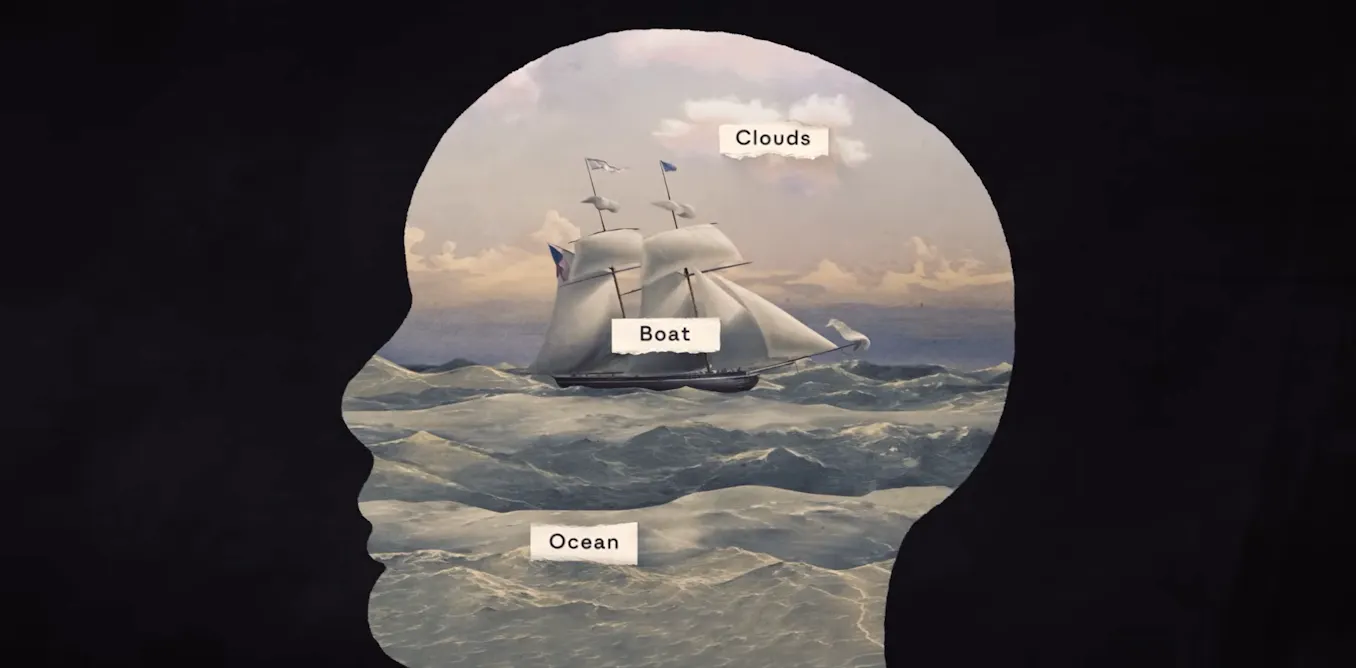
In a glossy video explaining the work, Anthropic depicts the contents of Claude’s “global workspace” as sailing ships afloat on a vast sea of unconscious mental activity.
How should we react to these developments? Do they provide evidence for artificial consciousness? If so, how strong is that evidence?
What is a global workspace?
We can start by asking whether Claude does indeed have a “global workspace”. This is not straightforward, for the theory gives no formal definition of a global workspace.
The notion is characterised only informally. The (typically implicit)…