Artificial Intelligence Market Set for Explosive Growth as Automation, Generative AI, and Intelligent Decision-Making Transform Industries
Publish Date: 2026-06-12 06:32:00
Source Domain: vocal.media
Artificial Intelligence (AI) is no longer a futuristic concept confined to research laboratories or science fiction. Today, it is one of the most transformative technologies shaping the global economy, influencing everything from healthcare and finance to agriculture, manufacturing, transportation, and consumer services.
Businesses, governments, and institutions worldwide are increasingly integrating AI into their operations to improve efficiency, automate processes, enhance decision-making, and create more personalized experiences. As data volumes continue to grow and computing power becomes more accessible, AI is moving from experimental applications to mission-critical business solutions.
The rise of generative AI, machine learning, natural language processing, and intelligent automation has accelerated adoption across nearly every industry. Organizations are investing heavily in AI technologies to remain competitive in an increasingly digital world.
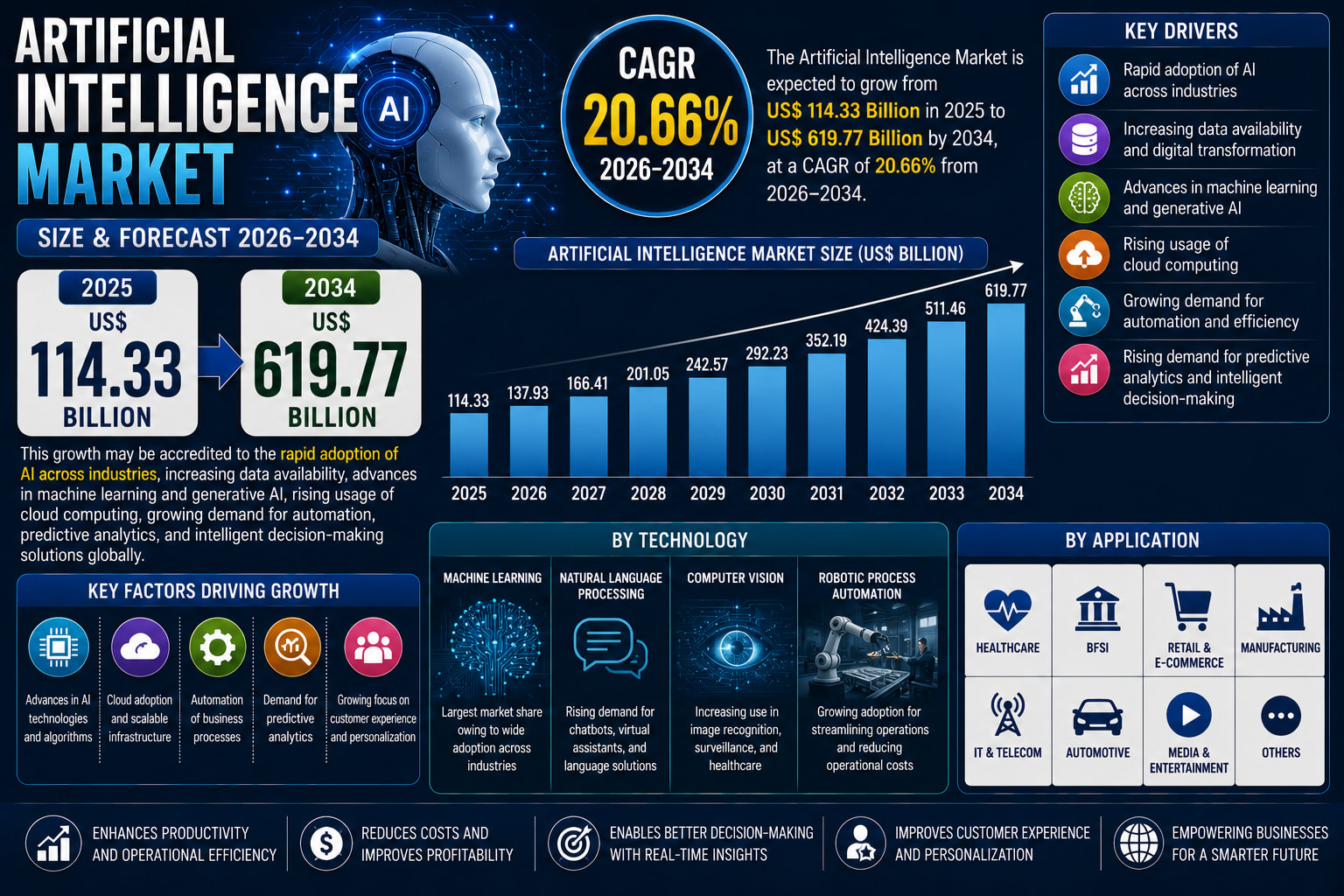
According to Renub Research, the Artificial Intelligence Market is expected to grow from US$114.33 billion in 2025 to US$619.77 billion by 2034, registering an impressive compound annual growth rate (CAGR) of 20.66% between 2026 and 2034. Growing adoption of AI-driven automation, cloud computing, predictive analytics, and intelligent business solutions is expected to fuel this remarkable expansion.
Download Free Sample Report
Artificial Intelligence Has Become a Foundation of Digital Innovation
Artificial Intelligence refers to technologies that enable machines and software systems to simulate aspects of human intelligence.
Through sophisticated algorithms and computational models, AI systems can learn from data, recognize patterns, make decisions, solve problems, and continuously improve performance.
Modern AI encompasses a wide range of technologies including machine learning, deep learning, natural language processing (NLP), computer vision, predictive analytics, robotics, and generative AI.
These technologies…