This Jacket Pulls Drinking Water From Thin Air – UT Austin News
This Jacket Pulls Drinking Water From Thin Air – UT Austin News
https://news.utexas.edu/2026/06/11/this-jacket-pulls-drinking-water-from-thin-air/
Publish Date: 2026-06-11 12:55:00
Source Domain: news.utexas.edu
Engineers at The University of Texas at Austin have developed a jacket that harvests drinking water directly from the air. The technology could benefit anyone who spends much time in areas without easy access to drinking water, from hobbyist hikers, campers and runners to agricultural workers, emergency responders and soldiers.
“Water harvesting from air is usually imagined as a stationary device such as a box, a panel or a large sorbent bed,” said Guihua Yu, chair professor of the Cockrell School of Engineering’s Walker Department of Mechanical Engineering and Texas Materials Institute and one of the leaders of the new research in Science Advances. “Here, we wanted to rethink the form of the technology. If the fabric itself can collect water from air, it opens a new direction for personal and portable water access.”
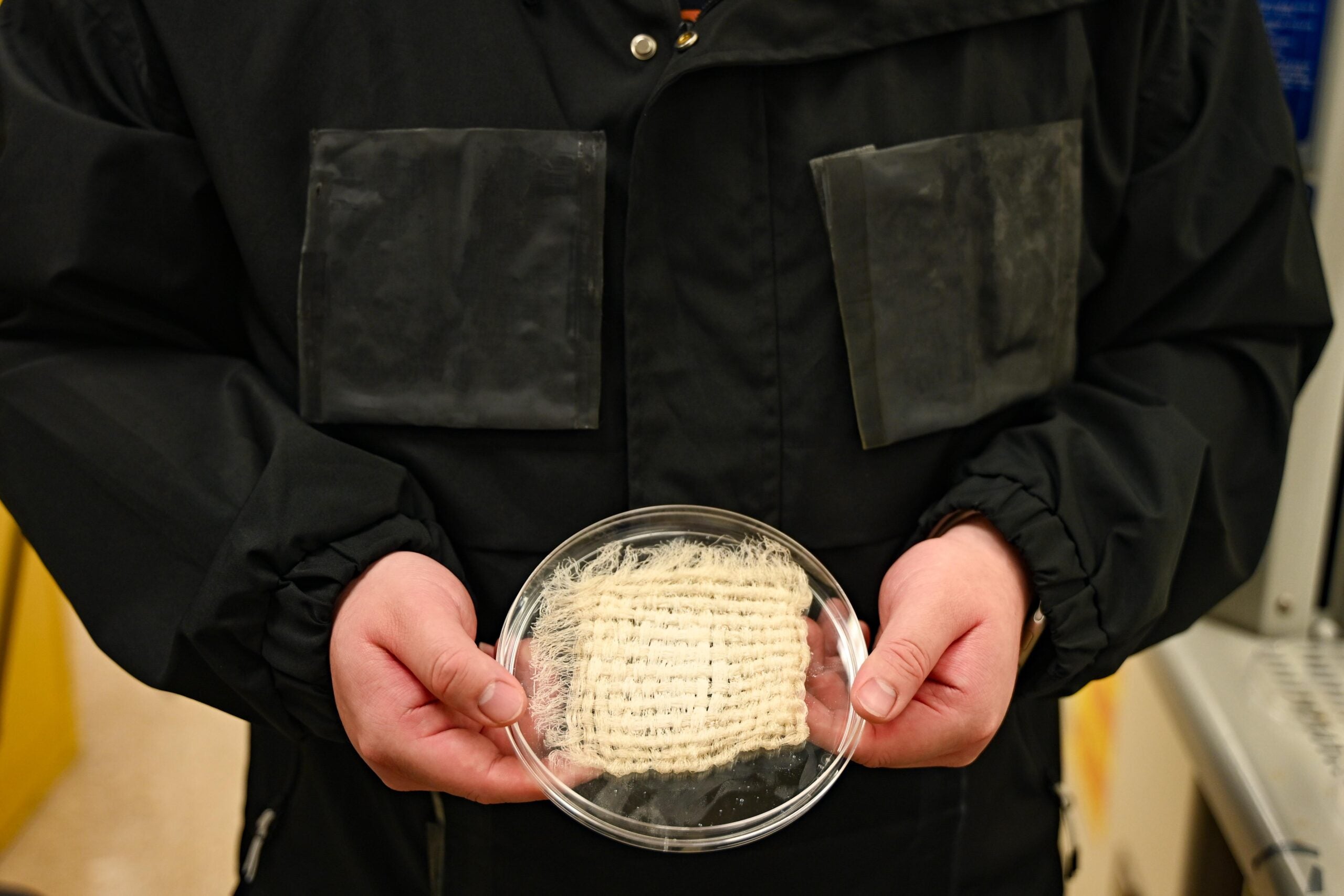
The textile incorporated into the jacket collects moisture and funnels it to detachable harvesting units. Those units are placed in a foldable collector piece and heated to produce the water.
The detachable harvesting units are placed in a foldable collector piece and heated to produce the water.
The jacket produced between 400 and 900 milliliters of drinkable water per day, about 14 to 30 ounces, depending on humidity levels.
Compared with conventional water-harvesting materials, the textile showed a three- to 10-fold improvement at scale. By focusing on the fibers rather than building another bulky device, the researchers overcame a common problem in the field.
“The important advance here is that the team did not simply make another material that absorbs water,” said Keith Johnston, co-author and chair professor of the Cockrell School of Engineering’s McKetta Department of Chemical Engineering. “They designed a pathway for water to move quickly, from vapor in the air, to liquid on the fiber surface, and then into the textile. That transport design is what allows the material to work not just in a small lab test,…