New material tackles one of the biggest barriers to scaling artificial intelligence
New material tackles one of the biggest barriers to scaling artificial intelligence
Publish Date: 2026-06-04 10:07:00
Source Domain: www.thebrighterside.news
Photonic chips sit deep inside the modern internet, routing the light pulses that carry emails, videos and AI requests around the world. They are fast, compact and essential. However, they still stumble at some of the most important jobs. This is especially true when light signals need to be converted, amplified or reshaped.
That weakness matters more now than it did a few years ago.
Generative AI systems push far more data back and forth between processors than a standard search query does. Every extra exchange adds pressure on the hardware that moves information inside and between data centers. In addition, what used to be a modest energy cost could become a much larger one. This will happen as AI systems expand and demand more from the networks underneath them.
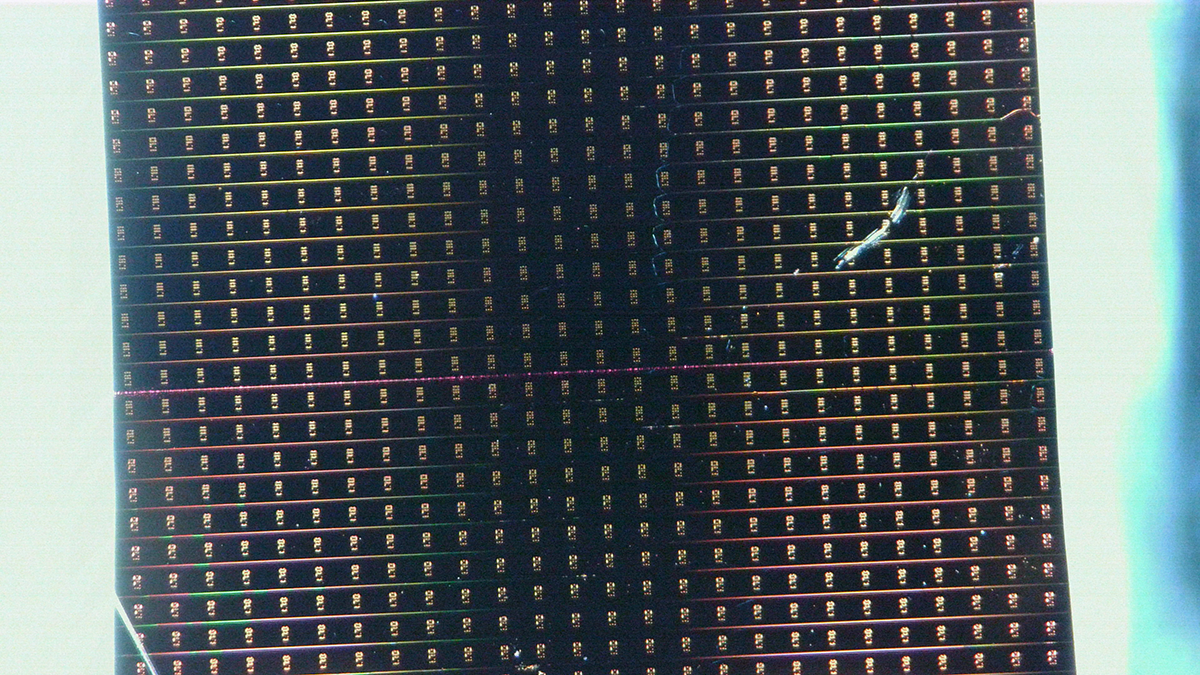
A team at Polytechnique Montréal says it has found a way to give photonic chips some of the functions they have long lacked. Writing in Science Advances, the researchers report a material that can be added directly onto silicon. This material lets light be processed on the chip itself, instead of being repeatedly handed off to extra components.
Pierre‑Luc Thériault, a PhD student in Engineering Physics and first author of the study, aligns an experimental setup used as part of this study. (CREDIT: Caroline Perron).
A missing function in silicon
The work targets a basic limitation in silicon photonics. Silicon is excellent for guiding light, which is why it has become central to optical interconnects, transceivers and other high-bandwidth systems. But it cannot naturally perform certain second-order nonlinear optical functions. These functions are needed for tasks such as light conversion, high-speed modulation and specialized light generation.
To get around that, engineers have generally taken one of two routes. They can build devices from other materials that have those properties, or they can add a second material onto silicon. Both approaches work, but they come with trade-offs in cost, processing…