Linux gamers can now use NVIDIA Reflex and AMD Anti-Lag 2 on any GPU thanks to a new open-source project

Publish Date: 2026-05-18 23:05:00
Source Domain: www.tweaktown.com
A new open-source project is giving Linux users a chance to experience low-input-latency gaming, finally closing a gap that Windows has long held over Linux. Called “low_latency_layer”, it adds support for NVIDIA Reflex and AMD Anti-Lag 2 to AMD and Intel GPUs on Linux.
The project (available on GitHub) essentially adds a Vulkan layer that implements VK_NV_low_latency2 and VK_AMD_anti_lag device extensions, bypassing official driver-level support from AMD, Intel, or NVIDIA to expose latency-reduction technologies directly to games.
Low-latency methods keep the CPU from falling too far behind the GPU. When frames linger in the pipeline, input appears older by the time it shows on screen, which is crucial in competitive shooters. NVIDIA Reflex and AMD Anti-Lag 2 address this by improving the synchronization between the game engine, CPU, and GPU.
VIEW GALLERY – 3 IMAGES
Low_Latency_Layer provides both extensions that work with any hardware. By default, it uses AMD Anti-Lag, but an environment variable can enable the NVIDIA path instead. For Proton games, another part called DXVK-NVAPI comes into play, forwarding relevant Reflex calls from Windows games via DXVK or VKD3D-Proton. Low_latency_layer then makes these calls work on Linux, even if official drivers do not support them.
This allows NVIDIA Reflex and AMD Anti-Lag 2 to run on any GPU. The developer says he started the project out of frustration with the state of Anti-Lag 2 support on Linux. Mesa’s Anti-Lag 2 implementation was unstable, disabled by default, and failed to match the performance of the proprietary Windows version.
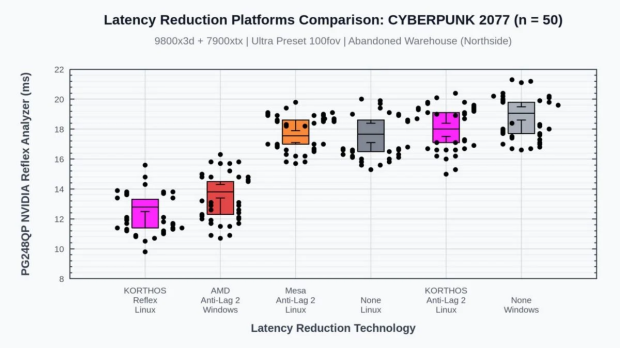
The project includes test results for Counter-Strike 2, Cyberpunk 2077, Resident Evil Requiem, and Marvel Rivals on an AMD Radeon RX 7900 XTX, showing significant latency improvements over normal rendering. In all tested games, low_latency_layer delivered the best latency, beating the Mesa Linux implementation and even the official Windows implementations.
The only downside here…