New MatterChat Model Helps AI to ‘See’ the Language of Science
New MatterChat Model Helps AI to ‘See’ the Language of Science
https://newscenter.lbl.gov/2026/05/18/new-matterchat-model-helps-ai-to-see-the-language-of-science/
Publish Date: 2026-05-18 11:07:00
Source Domain: newscenter.lbl.gov
From writing emails to generating computer code, much of the artificial intelligence prevalent in our daily lives has succeeded by mastering one domain: text. However, this leaves a major blind spot in the physical sciences, where models depend on the high-resolution, three-dimensional data of the physical world, like the intricate lattice of atoms in a crystal. Delivering on the promise of using AI for science requires teaching these data-driven text models to seamlessly “talk to” physics-based models.
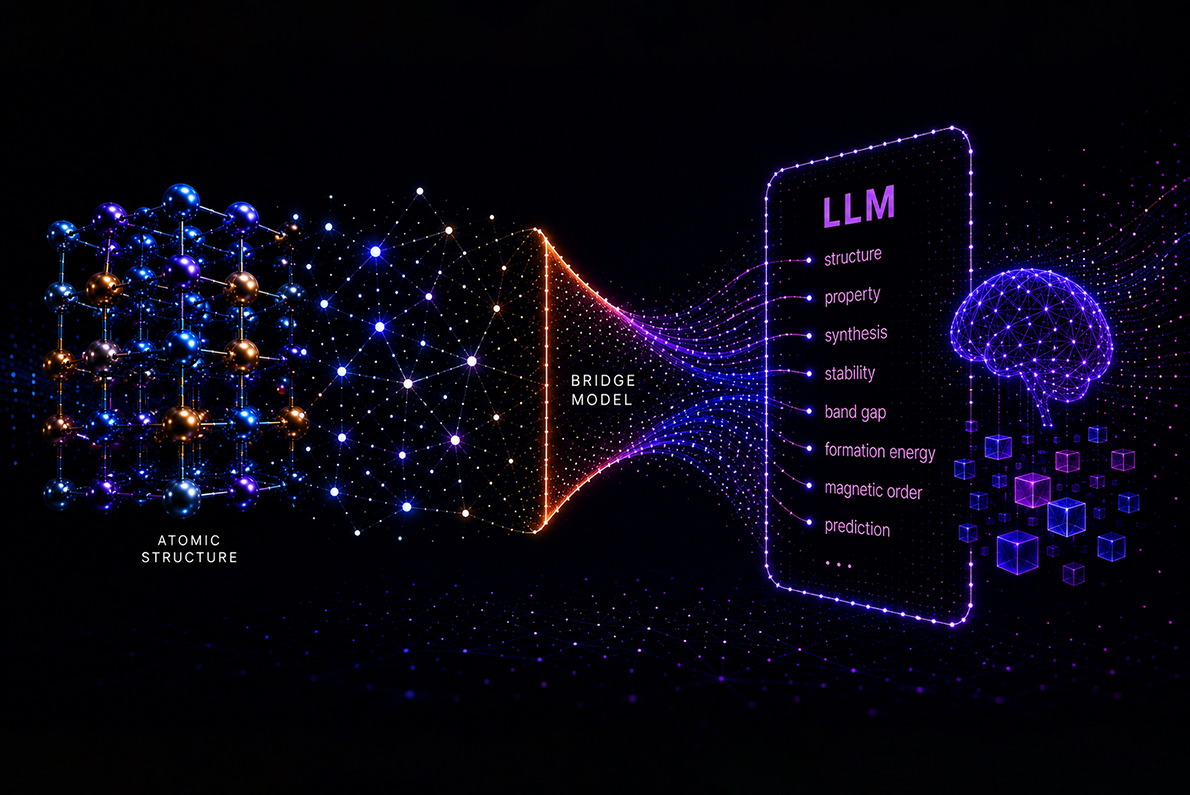
Now, a new AI framework from Lawrence Berkeley National Laboratory (Berkeley Lab), called MatterChat, solves this problem by creating a specialized “bridge.” It connects the conversational power of a Large Language Model (LLM) with a physics-based AI that models “interatomic potentials”: the complex physical forces between atoms. The resulting system already significantly outperforms general-purpose AI tools like GPT-4 at predicting material properties, and the team hopes it can accelerate scientific discovery by serving as a robust research partner that provides grounded insights and generates step-by-step instructions for synthesizing novel materials.
A paper describing this work was recently published in Nature Machine Intelligence.
“Traditional simulations can provide the physical rigor required for materials science, yet their computational cost remains prohibitive for high-throughput screening. Conversely, while LLMs excel at rapid knowledge synthesis, they inherently lack the ‘structural vision’ to interpret materials directly from their underlying atomic coordinates,” said Yingheng Tang, a postdoctoral researcher in Berkeley Lab’s Applied Math and Computational Research Division (AMCR) and lead author on the paper. “MatterChat was built to solve this dilemma, empowering LLMs with a structural ‘vision’ that allows researchers to leverage their full potential for solving complex, real-world materials…