A cybersecurity harbinger: Oracle front-runs AI model threat with new customer security advisory
A cybersecurity harbinger: Oracle front-runs AI model threat with new customer security advisory
Publish Date: 2026-04-30 15:01:00
Source Domain: siliconangle.com
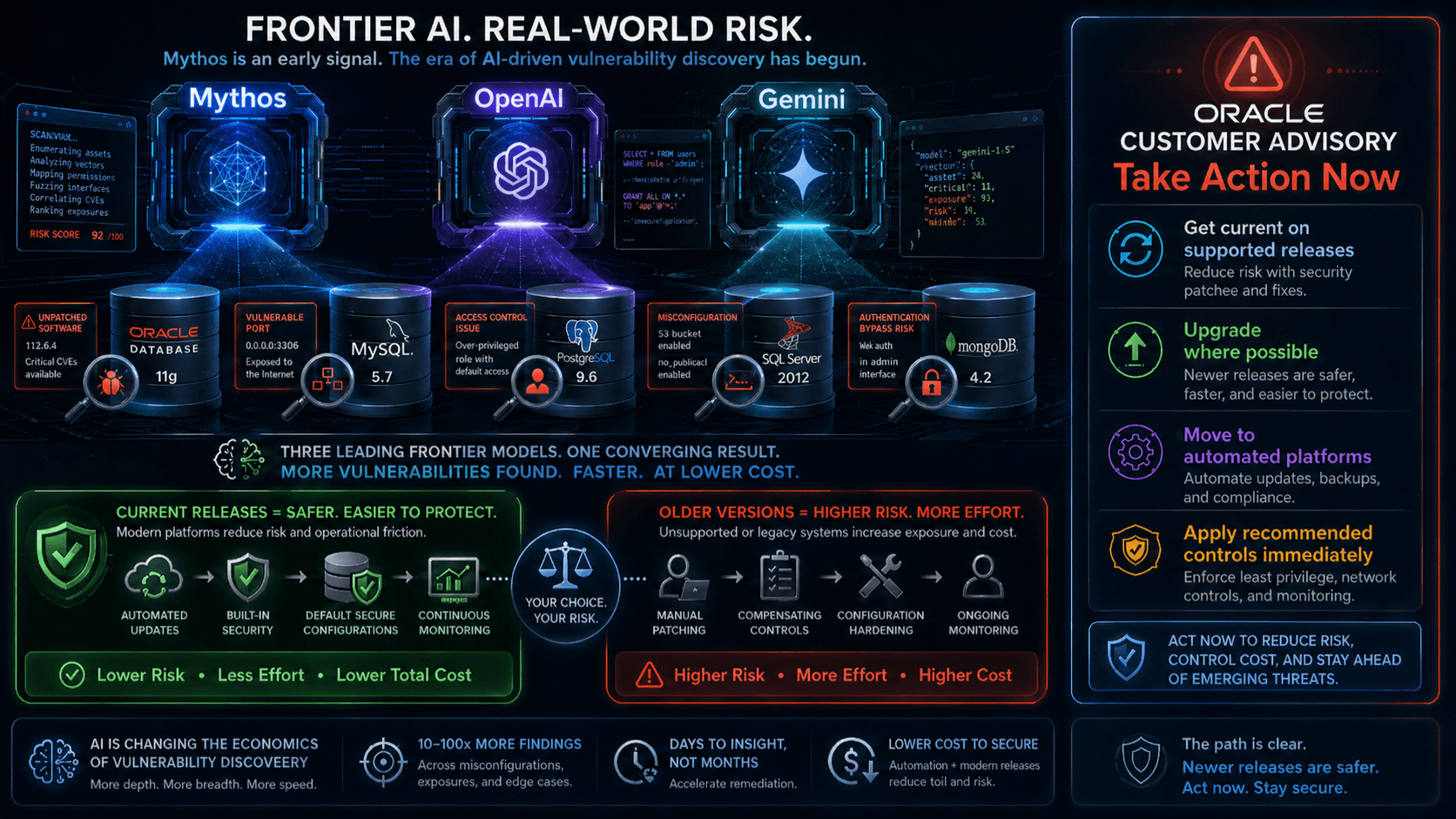
SiliconANGLE was able to review an Oracle Corp. security alert that went out to customers this week. We believe it was a direct response to Anthropic PBC’s new Mythos artificial intelligence model, and other frontier models, that significantly lower the cost for attackers to discover exploits.
In this Breaking Analysis, we give you our initial take on this development. Here’s the background:
Software security has entered a new phase. Not only are models getting better at writing code; they’re getting materially better at reading code, reasoning across systems and finding exploitable vulnerabilities that change the threat model by dramatically lowering the cost for attackers.
Anthropic’s limited release of Mythos is an important milestone. In our view, Mythos should not be seen as a one-off product announcement or an Anthropic-only development. Rather it’s an early signal of where frontier models are headed – toward deeper software understanding, automated vulnerability discovery and eventually more autonomous exploitation approaches.
We do not believe the industry should over-rotate on Mythos as a standalone event. OpenAI Group PBC, Google LLC and other leading model providers have the technical capacity, research depth and, in some cases, greater compute capacity, to deliver similar capabilities. Tasks that once required scarce expert labor – code review, dependency analysis, configuration assessment and exploit-path discovery – are becoming cheaper, faster, automated and more scalable.
This has profound implications for tech companies, their customers, enterprise software firms, and is especially acute for databases. Databases sit at the center of the enterprise attack surface. They hold the crown jewels, connect to a sprawling application ecosystem, depend on complex identity and access policies, and often carry years of accumulated configuration debt (and consequent exposures). As advanced models reduce the cost of finding weak points,…