Abandoned Pennsylvania mines and waste-heat recycling could make the state’s massive new data centers far more sustainable
Publish Date: 2026-03-09 08:54:00
Source Domain: theconversation.com
The electricity needed to power new Pennsylvania data centers already in advanced stages of planning could power 11 million homes – nearly twice the total number of households in the state.
Companies that want to build data centers to expand their cloud and artificial intelligence computing are drawn to Pennsylvania due to its proximity to major East Coast cities, relatively affordable land and electricity, and legacy industrial infrastructure. For instance, there is a plan to turn an abandoned steel mill in Pittsburgh into a high-density data center that can leverage the existing infrastructure for electricity and water supply.
If all data centers in advanced planning are built, it could total about 13 gigawatts of electrical capacity.
As more data centers are proposed across the state, residents and policymakers are asking important questions: How much energy and water will these data centers use? And what can be done to manage their environmental footprint?
As a professor of architectural engineering at Penn State, my research focuses on optimal design and control of data center cooling systems. I know that a key part of the answer to minimizing the negative effects of data centers lies in cooling.
Data centers generate a lot of heat
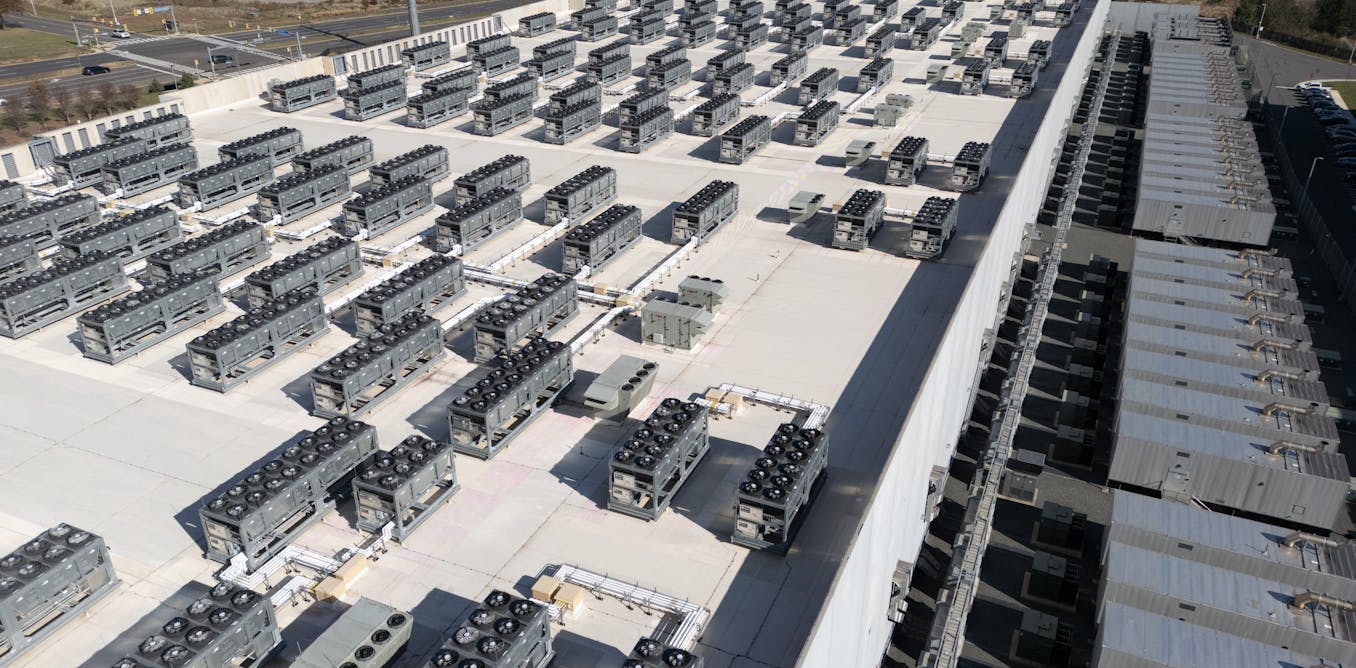
Every bit of electricity that a data center consumes is converted into heat that must be removed and released into the environment. Cooling systems, including chillers and cooling towers, are mission-critical infrastructure.
Without effective cooling, temperatures in computing devices would quickly rise to damaging levels, forcing systems to shut down. In November 2025, the Chicago Mercantile Exchange experienced a major outage when a data center’s cooling system failed. It halted trading for hours.
Data centers currently account for about 4.4% of total U.S. electricity consumption and are projected to rise to 6.7% to 12.0% in 2028, according to Lawrence Berkeley National Laboratory.
They also consumed nearly…