AI, war in Iran, and the sovereignty struggle over autonomous technology
AI, war in Iran, and the sovereignty struggle over autonomous technology
Publish Date: 2026-02-28 09:43:00
Source Domain: americanbazaaronline.com
“The whole difference between war and peace is only a question of reconciling thought with reality.”
“We live consciously for ourselves but serve as an unconscious instrument for the achievement of historical, universally human goals.”
Leo Tolstoy
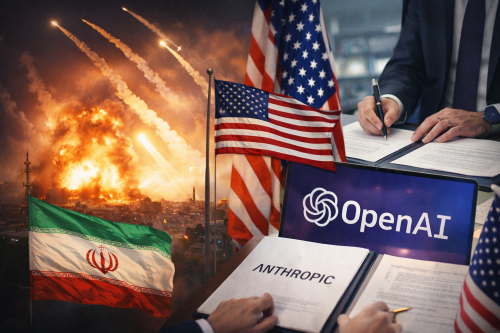
This morning, the United States and Israel launched coordinated military strikes against Iran, marking a dramatic escalation in regional tensions and underscoring how modern warfare is no longer defined solely by tanks, missiles, or nuclear arsenals — but by code.
On the same day, the U.S. government effectively barred the artificial intelligence company Anthropic from federal deployment after a dispute over military access to its advanced AI systems and signed a deal with OpenAI.
The juxtaposition is striking: kinetic warfare unfolding in real time while a parallel battle over AI control plays out in Washington. These events reveal a profound shift in how war is conceived, executed, and governed.
Artificial intelligence is no longer experimental within defense systems but is embedded. AI drives satellite image analysis, missile defense targeting algorithms, cyber-threat detection, logistics optimization, drone swarm coordination, battlefield simulations, and predictive threat modeling.
READ: Sreedhar Potarazu | AI sovereignty race: US and China lead, India watches (
The modern military decision cycle—observe, orient, decide, act—has been compressed by machine learning systems capable of processing data at speeds impossible for human analysts.
The strategic advantage is clear: faster detection, more precise targeting, reduced personnel exposure, and improved coordination across domains—land, sea, air, space, and cyber.
For the Pentagon, access to frontier AI models represents not just efficiency but deterrence. AI enhances missile defense systems, strengthens cybersecurity infrastructure, and supports real-time decision assistance for commanders. In theory, it reduces human…