US State Colorado Wants Operating Systems (Inlcuding Linux) to Tell Every App How Old You Are
US State Colorado Wants Operating Systems (Inlcuding Linux) to Tell Every App How Old You Are
https://itsfoss.com/news/colorado-age-attestation-bill/
Publish Date: 2026-02-24 05:32:00
Source Domain: itsfoss.com
Age verification online is regrettably becoming the norm. Platforms are increasingly asking users to prove their age before accessing certain content or services. That usually means handing over personal data, sometimes even biometric data, to a third-party provider, then hoping they do not sell it, suffer a breach, or both.
Now, the U.S. state of Colorado is mulling over a bill to implement age reporting for installing apps on computers and mobile devices.
Age Attestation, What?
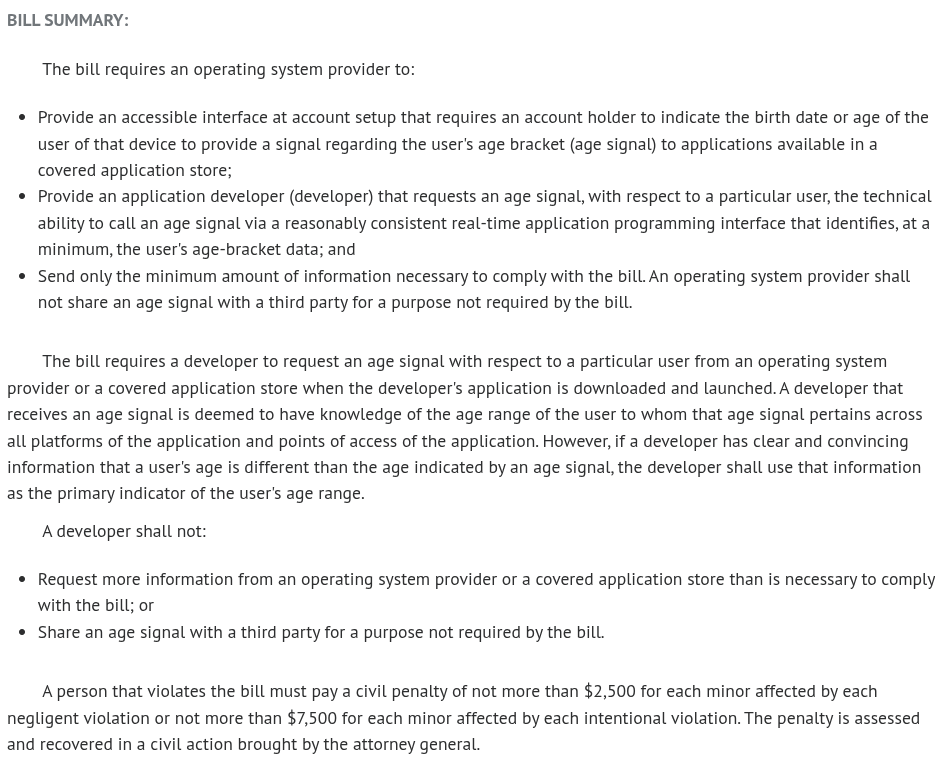
Senator Matt Ball and Representative Amy Paschal presented this bill, Age Attestation on Computing Devices (SB26-051), to the Colorado Senate, where it was assigned to the Business, Labor, and Technology Committee.
Currently only a proposal, the bill calls for operating system providers like Microsoft, Google, Apple, and Canonical to present an interface during device account setup that asks the account holder (a person in Colorado) to specify the birth date/age of the device’s user.
That age data is then translated into an “age signal,” which apps can call on via an API when a user downloads or launches them. The bill claims that this refers to non-personally identifiable data taken from a user’s birth date or age.
The age signal does not hand over a specific birthdate to developers. It works in four age ranges — under 13, 13 to under 16, 16 to under 18, and 18 and above.
The bill also explicitly states that only the minimum amount of information necessary should be shared. Neither the OS provider nor developers are allowed to pass the age signal to third parties for purposes outside of what the bill requires.
On paper, the fines for violations sound like a serious deterrent. Up to $2,500 per minor affected for a negligent violation and up to $7,500 per minor for an intentional one. For a platform with millions of minor users, those numbers could stack up fast.
But the penalty is only triggered if the state Attorney General chooses to bring a civil…