Scientists harness AI to discover a rise in floating algae across the global ocean
Scientists harness AI to discover a rise in floating algae across the global ocean
Publish Date: 2026-01-28 09:40:00
Source Domain: www.theinvadingsea.com
By Dyllan Furness, USF College of Marine Science
For the first time and with help from artificial intelligence, researchers have conducted a comprehensive study of global floating algae and found that blooms are expanding across the ocean. These trends are likely the result of changes to ocean temperature, currents and nutrients, according to the authors, and could have a significant impact on marine life, tourism and coastal economies.
Led by researchers at the University of South Florida (USF) and the National Oceanic and Atmospheric Administration (NOAA), the study demonstrates the power of artificial intelligence as a tool for processing large amounts of ocean data.
These figures show the change in density of global floating algae in the 20 years between 2003 and 2022. (Credit: Qi et al.)
“While regional studies have been published, our paper gives the first global picture of floating algae, including macroalgal mats and microalgal scum,” said Chuanmin Hu, professor of oceanography at the USF College of Marine Science and senior author of the paper published this month in Nature Communications. “Our results show that the global ocean now favors the growth of floating macroalgae.”
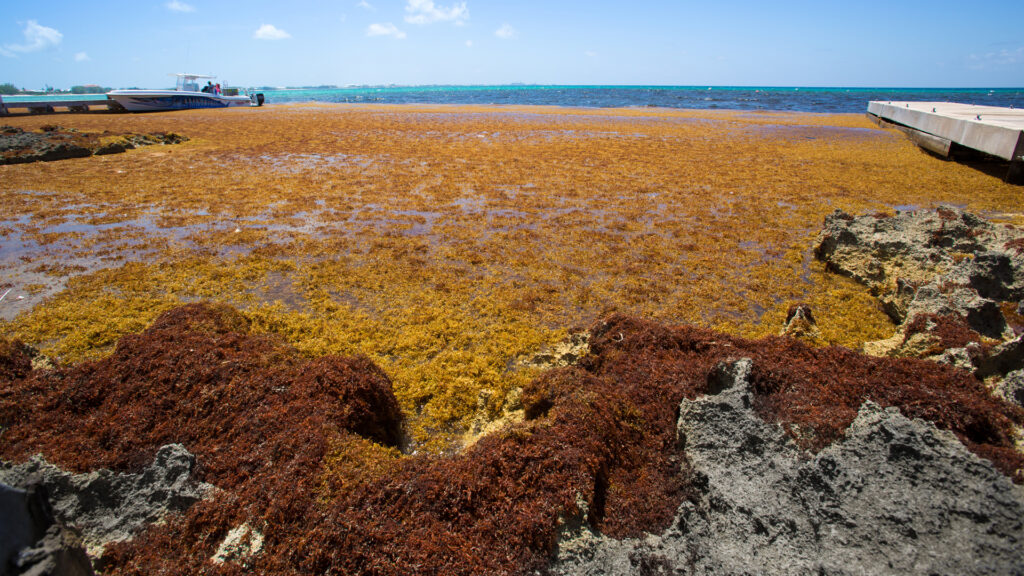
Hu refers to macroalgae, such as seaweed, as a double-edged sword. In open water, they can provide critical habitat for marine life and have a positive impact on fisheries, serving as a nursery for many species. But once the algae reach coastal waters, the decaying biomass can cause considerable harm to tourism, economies, and the health of people and marine life.
Between 2003 and 2022, both microalgal scum and macroalgal mats expanded around the globe. Microalgae on the ocean surface saw a modest but significant increase of 1% per year. However, blooms of macroalgae increased by 13.4% per year in the tropical Atlantic and western Pacific, the authors found, with the most dramatic increase in biomass occurring after 2008. The cumulative size of…